
On March 26th, 2026, the Florida Board of Governors, with no warning, pulled Sociology out of the general education curriculum in 12 Florida public universities. Sociology can still be taught as an elective, but it can no longer count as a general education course.
As a sociologist, you’d think I’d be furious and terrified. Honestly, I have mixed feelings about this. I’ll try to tackle this in pieces.
Academic Freedom
If you’ve read any of my other posts on my blog, you’ll know that I’m a strong advocate for academic freedom. It’s important to what we, as college professors, do in our research and in our classes. We need to be able to discuss controversial topics. We need to be able to study them. And we need to be able to do that without fear of reprisals.
The Florida Board of Governors, working with the Florida State Legislature, has 100%, violated academic freedom. This isn’t really in question, even though Ray Rodrigues, who spearheaded this effort among the Florida Board of Governors, wants to try to claim otherwise. His logic on this point is absolutely flawed. Here’s what he said at the meeting,
“The media has framed a false choice before the board today. That you either violate academic freedom and comply with state statute. Or you violate state statute and comply with academic freedom. My recommendation to you is to reject that false choice. The path to preserve academic freedom and preserve compliance with Florida statutes is clear: remove sociology 1000 and 2000 courses from all general education classifications.”
The Florida statute to which he is referring is this one, which I’ve written about before. It prohibits teaching anything that is, “Unproven, speculative, or exploratory.”
This isn’t complicated to understand. If academic freedom means faculty have the right to cover any topic that is related to their course, regardless of whether it is unproven, speculative, or exploratory, and the Florida Legislature has prohibited that very thing, that is a violation of academic freedom. Removing the ability of sociologists to discuss gender, race, sexuality, prejudice, discrimination, and so forth for any reason when those topics are clearly related to what sociologists study is a violation of academic freedom.
Ray Rodrigues is wrong.
He knows he’s wrong.
But in classic authoritarian double-speak, he’s hoping he can say, “I’m not violating academic freedom” while literally violating it, and that people will believe him. Looking people straight in the face and telling them that they are doing the opposite of what they are doing appears to be an increasingly common component of the Florida conservative playbook. Lie, deny you’re lying, and hope everyone believes you.
Restricting what faculty can do in the classroom when they are on topic (which is key to academic freedom) is a violation of academic freedom.
With that out of the way, on to my next point…
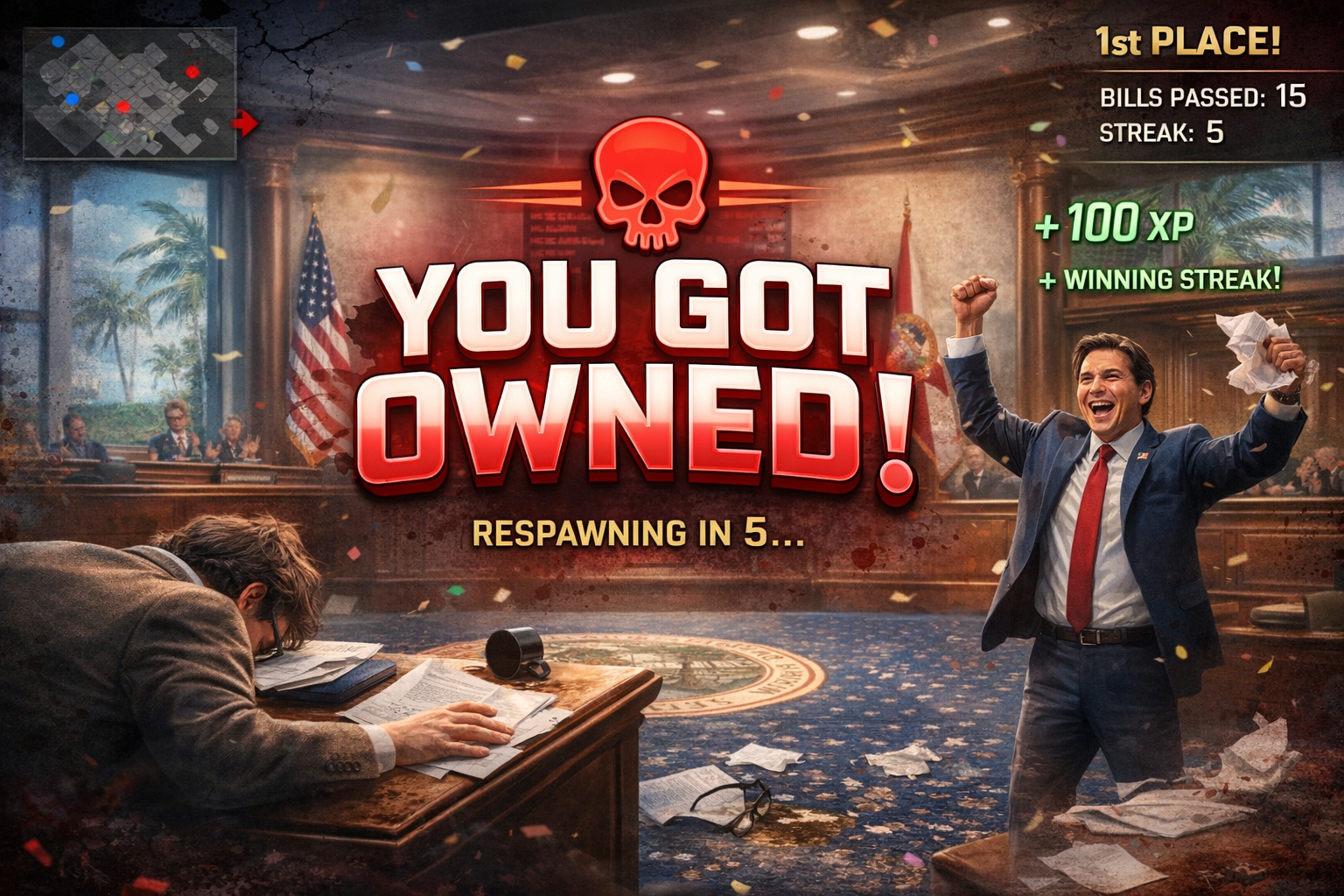
Sociologists Got Owned
I hate to admit it, but Republicans in Florida just outsmarted sociologists. This is part of the reason why sociologists kind of deserve this.
If Republicans intended this, well, damn. It was smart.
Here’s what they did:
(1) Gut Introduction to Sociology and restrict what faculty can teach in Introduction to Sociology.
(2) Hear complaints about the new sociology curriculum and textbook, suggesting that faculty are not happy about the revised sociology course.
(3) Use those complaints to justify removing the course from general education entirely.
Honestly, that’s a pretty brilliant strategy. Clear victory for Republicans. Whether intentional or not, the sequence of events worked to their advantage. If this was intentional, they set sociologists up, sociologists took the bait, and then Republicans closed the trap. Sociology is out of the general education curriculum.
Again, if that was intentional, it was a brilliant move. Sneaky, but brilliant.
(Honestly, I don’t think they planned all of this in advance, but they took advantage of the situation and owned sociologists in the process.)
Sociologists Made Ourselves Vulnerable
I attended a Pacific Sociological Association conference a few years back. I don’t follow the politics of that association closely, but a friend was there, and his mentor, Jonathan Turner, was on the docket arguing that the growing percentage of sociologists who identified as “critical sociologists” was harming the discipline. His basic argument, which he has published before, was that, if more sociologists focused on just making social and political arguments (a.k.a. “public sociology,” “social criticism,” or “critical sociology”), it becomes easier and easier for government officials and those who make social policy to ignore sociology because it is no longer based on data. He contrasted sociology with psychology, which seems to have gone all in on being perceived as a “hard” science and has not followed suit in opening the doors to “critical psychologists.”
Actual footage of Jonathan Turner upon hearing what the Florida Board of Governors just did! (jk)
I don’t know what percentage of sociologists identify as “public sociologists” or “critical sociologists.” It’s not just 1 or 2. I could name a dozen off the top of my head. They are vocal and, not surprisingly, strongly advocate for their position.
What is the problem with critical or public sociology?
While critical sociologists may gather data, in some cases, the research begins with a normative commitment, and the empirical work is oriented toward supporting that commitment. The agenda is set in advance. The data are the support they need to push their agenda. So, if they have data, it is agenda-driven, not objective.
Honestly, that’s bad science.
I’m going to get shit for saying that.
This is exactly why I criticize people claiming to do “creation science.” They start with the conclusion and work backwards. It isn’t science. It’s ideology masquerading as science.
For me, data come first. Conclusions come second. We find what we find. If others want to interpret our data in different ways, that is up to them. My job, as a sociologist, is to study social topics and report what I find.
Outside of my classroom and outside of my objective, scholarly work (say, on a personal blog like this one), I can have opinions. I can advocate for specific political ideas. Weber warned that when scholars bring political commitments into their scientific work, they risk undermining the credibility of the discipline itself. Following Weber, I’m free to be political outside of class and outside of my scholarly work. If I bring it into my classroom or scholarly work, well, I’ve invited politicians into my classroom and research as well.
Turnabout is fair play.
And the politicians know all of this. And that makes it easy for policymakers to frame the discipline as ideological rather than scientific.
Here’s what Ray Rodrigues said in that meeting:
“As witnessed by their own themes, goals, and words, the ASA declares that sociology’s mission goes beyond understanding societies and now extends to its transformation. Sociology as a discipline is now social and political advocacy dressed in the regalia of the academy.” (Ray Rodrigues)
Well, shit.
He’s correct on this point.
He just owned sociologists.
And sociologists probably deserve this.
Had we policed our discipline and drawn clearer boundaries between advocacy and empirical research, things might have turned out differently.
We didn’t. And we got fucked.
We invited it, and Florida Republicans delivered.
To be clear, I’m not saying I support what Republicans have done. I don’t think any discipline deserves political suppression. Recognizing how a discipline made itself vulnerable is not the same as endorsing the intervention. But by becoming a discipline that is deeply entangled with social activism and political agendas, we made ourselves vulnerable to precisely this type of intervention.
This is on us.
The worst part about this outcome, though, is that the American Sociological Association and most sociologists won’t take the correct lesson from this. They will continue to complain about conservatives and double down on being critical sociologists.
(Can I identify as a data scientist now?)
Hypocrisy Caveat
Some of those reading this may think I’m a hypocrite. I’ve published work that is arguably critical.
That’s true. Sort of. I’d like to think that I’ve studied topics that are interesting and have social and political implications. I’ve never started with my conclusions and worked backwards.
I’ve also never gathered data with an agenda other than answering the question I’m asking. I’ve never misrepresented my data. I’ve always reported exactly what the data say. I have embraced open science principles and will share my data and code with anyone. The data are sacred. You never fuck with the data.
Yes, a lot of my research runs counter to prevailing wisdom in the field. That is, in a sense, me being critical of what other scholars have done. But it’s because those other scholars are wrong. 😉
I’m not doing politics or social activism in my research. There is a difference between research with political implications and research conducted for political purposes. I try to do the former, not the latter.
If people want to call me a hypocrite, fine. I’ll accept the label.
But I’m sticking to what I wrote above.