
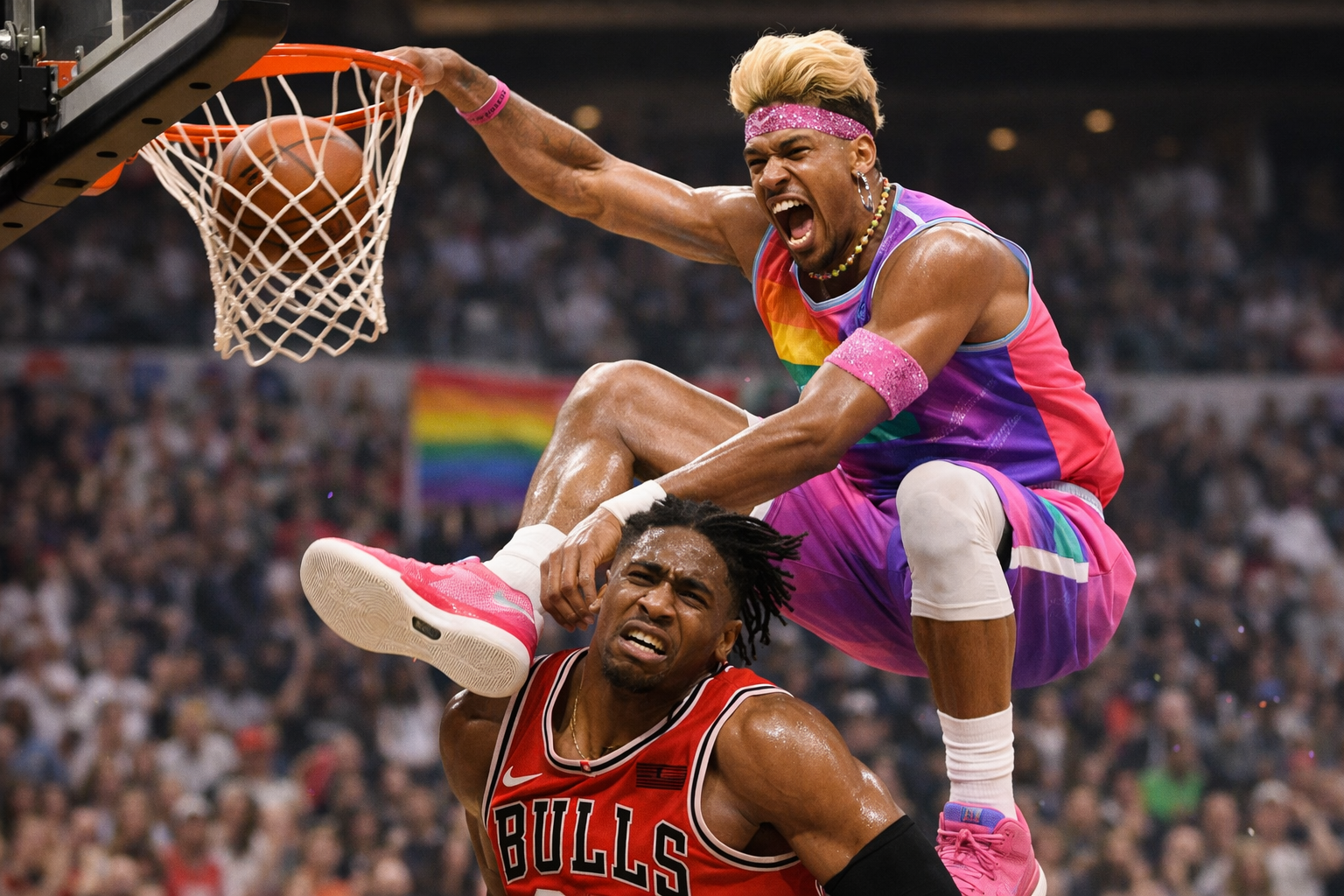
I don’t follow the NBA all that closely. But a recent story about Jaden Ivey caught my attention, and not because of basketball.
It raises a genuinely difficult question—one that I don’t think has an easy answer.
Let me start with where I stand.
I strongly support religious freedom. People have the right to believe what they want and, to a large extent, to say what they believe. That includes beliefs that others find offensive, outdated, or just wrong.
At the same time, the Chicago Bulls (and the NBA more broadly) are not the government. They are private organizations. They also have rights—particularly the right to set expectations for behavior within their workplace.
And that’s where things get complicated.
What Actually Happened
According to reporting, Ivey was waived for “conduct detrimental to the team” after multiple public statements on Instagram Live in which he:
- Described LGBTQ identity as “unrighteousness”
- Said that God does not hear the prayers of “sinners”
- Claimed that Catholicism is a false religion
These weren’t private beliefs. These were repeated, public statements to a large audience.
That distinction matters.
This Is Not Just About Belief
It’s tempting to frame this as:
“Was he fired for his religious beliefs?”
But that’s probably the wrong question.
A better question is:
“Was he let go for behavior that conflicted with the norms and functioning of his workplace?”
There’s an important difference between:
- Holding a belief
- Expressing that belief in a way that publicly condemns identifiable groups of people
The first is protected. The second—especially in a workplace context—can have consequences.
The Real Tension
What makes this case interesting is that it brings two real principles into conflict:
1. Religious freedom and free expression
2. The right to work in an environment free from harassment and denigration
Both matter.
Both are worth protecting.
And they don’t always fit together neatly.
The NBA, like many modern organizations, has made it clear that it values inclusion—particularly with regard to LGBTQ individuals. If you are publicly describing those identities as immoral or “unrighteous,” that’s not just abstract theology. That has real implications for:
- Teammates
- Staff
- Fans
- The organization’s public identity
At some point, that becomes a workplace issue.
Why I (Reluctantly) Side with the Bulls
I come down on the side of the Bulls here—but not because I think Ivey shouldn’t be allowed to believe what he believes.
He should.
The issue is not belief. It’s conduct.
When an employee repeatedly makes public statements that:
- Undermine the dignity of groups represented within the organization
- Conflict with the organization’s stated values
- Potentially create a hostile or divisive environment
…then the organization has to respond.
That doesn’t mean this is a clean or comfortable decision. It isn’t.
And it comes with a cost.
The Cost We Don’t Talk About
If we say:
“You can believe it, but you can’t say it in ways that harm others in the workplace”
Then we are also saying:
Some religious doctrines cannot be expressed openly in certain institutional settings.
That’s a big deal.
It means that, in practice, some forms of traditional religious expression are being:
- Constrained
- Privatized
- Or pushed to the margins of public institutions
Even if that constraint is justified, it’s still a constraint.
We shouldn’t pretend otherwise.
This Isn’t Just About the NBA
What we’re really seeing here is a broader social shift.
Modern institutions—corporations, universities, sports leagues—are increasingly built around norms of:
- Inclusion
- Equality
- Respect across identity groups
At the same time, some religious traditions continue to teach:
- That certain identities or behaviors are immoral
- That some belief systems are false or inferior
Those two systems can coexist in theory.
In practice, they increasingly collide.
Where Do You Draw the Line?
This is where things get uncomfortable.
Most people would agree that religious freedom has limits. We don’t allow people to harm others in the name of religion. That’s not controversial.
But the harder question is:
Where is the line when the “harm” is social, psychological, or institutional rather than physical?
Is it:
- Direct harassment of coworkers?
- Public condemnation of groups?
- Expression that undermines workplace cohesion?
Reasonable people can disagree.
The Bigger Question
This is the question that really interests me:
As societies modernize, will religions be forced to adapt to those norms—or be pushed to the margins?
And a follow-up:
Is that outcome acceptable?
I don’t think there’s an easy answer.
On the one hand:
- Societies have a legitimate interest in protecting people from discrimination and hostility
On the other hand:
- Religious traditions don’t just disappear because they become unpopular or inconvenient
What we’re left with is a tension that isn’t going away anytime soon.
The Bottom Line
Jaden Ivey has the right to believe what he believes.
The Chicago Bulls have the right to decide that his public behavior is incompatible with their organization.
Both of those things can be true at the same time.
And that’s exactly what makes this such a difficult—and important—issue.
Because it forces us to confront a reality we’d often rather avoid:
In a pluralistic society, not all values can coexist without conflict.