
I want to start with something simple: I genuinely hope people are finding community, meaning, and support wherever they can. If joining a religious community helps someone feel less isolated or more grounded, that’s a good thing.
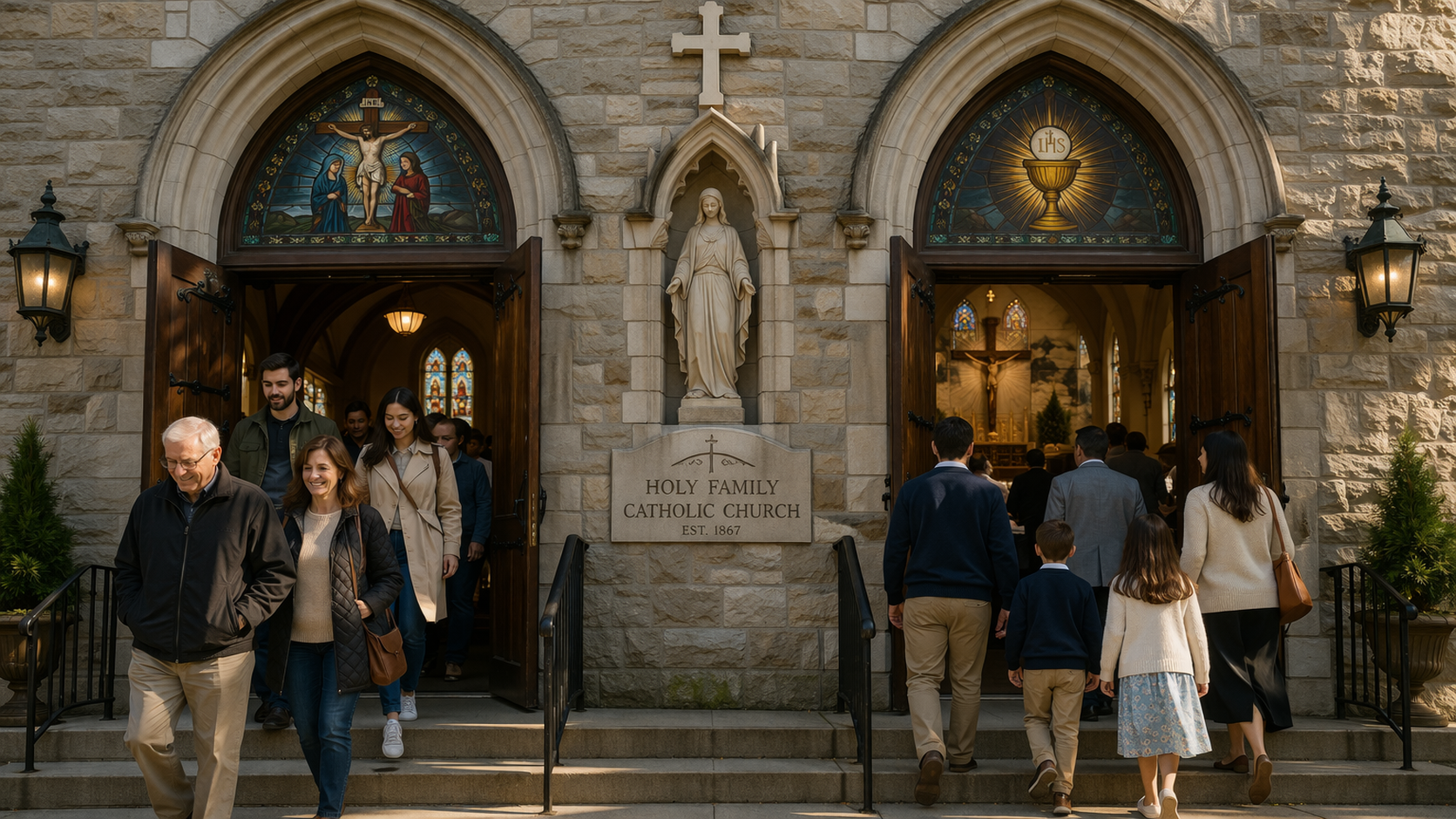
But that’s a different question from the one implied in a recent New York Times article by Elizabeth Dias, which suggests that the Catholic Church in the United States may be experiencing something like a revival.
That claim deserves a closer look.
Anecdotes Are Not Trends
The article reports that several Catholic dioceses are seeing increases in the number of adults joining the Church this Easter. Some of the numbers are notable on their own:
- Detroit: 1,428 new Catholics (highest in 21 years)
- Washington, D.C.: 1,755 (up from 1,566 last year)
- Des Moines: a 51% increase
At first glance, that sounds like a surge. But there are some basic problems with how the story is constructed.
First, we are given raw counts, not rates. We don’t know what proportion of the population these numbers represent, whether retention is improving, or whether the overall Catholic population is growing. Without denominators, we cannot identify a trend—only isolated increases.
Second, the data are selective and anecdotal. The article itself notes that it gathered data from “two dozen dioceses.” There are roughly 176 Catholic dioceses in the United States. That means we’re looking at a small, non-random slice—likely places where increases are already happening.
This is not how you establish a national trend. It’s how you tell a compelling story.
Let’s Do the Math
Still, let’s take the article seriously and try to estimate the scale of what’s being described.
Suppose we apply these increases broadly. If each of the roughly 176 dioceses in the U.S. added an extra 200 to 500 converts this year, that would amount to:
- Low estimate: ~35,000 additional converts
- High estimate: ~90,000 additional converts
That sounds substantial—until we put it in context.
In prior work, I estimated that about 0.6% of U.S. adults leave religion each year. With roughly 260 million adults in the U.S., that translates to about:
- ~1.5 million people leaving religion annually
Even under generous assumptions, then, these additional Catholic converts would offset only about 2% to 6% of the number of people leaving religion each year.
And that’s before we consider two important reasons why even this estimate is too high.
Why This Estimate Is Probably Inflated
First, we are almost certainly overgeneralizing. The New York Times is drawing from a limited and non-representative sample of dioceses. There is no reason to assume that all dioceses experienced similar increases.
But more importantly, many of these “converts” are not coming from nonreligion at all. They are switching from other religious traditions—for example, from Protestant denominations or other faiths into Catholicism.
From the perspective of secularization, that distinction matters.
If someone moves from one religious tradition to another, the total number of religious people in society does not increase. It is not growth—it is reshuffling within the religious marketplace.
In other words, even if every one of these new Catholics represents a real increase—and many do not—we are still looking at a number that is dwarfed by the far larger flow of Americans leaving religion altogether.
What’s More Likely Going On
If this isn’t a revival, what explains the increases?
There are several plausible explanations that fit what we already know:
- Post-COVID rebound: Many churches saw declines during the pandemic when in-person services stopped. Some of this may simply be a return to baseline.
- Delayed conversions: People who might have joined earlier postponed that decision and are now entering.
- Local variation: Some dioceses may be particularly effective at outreach or benefiting from local conditions.
- Niche growth within broader decline: Even as overall religious affiliation declines, certain subgroups or traditions can experience short-term increases.
None of these requires a reversal of long-term secularization trends.
This Is Not a Revival
The broader data on religion in the United States have been remarkably consistent over the past two decades: religious affiliation has declined, the share of the nonreligious has increased, and switching out of religion continues at a much higher rate than switching in. Admittedly, decline has flatlined over the last three years or so. But that suggests that just as many people are leaving as are joining.
Nothing in this article provides evidence that those trends have reversed.
What we have instead is a familiar pattern in media coverage of religion: a shift from stories about decline to stories about resurgence, often based on anecdotal data and short-term fluctuations.
But small increases are not reversals. And anecdotes are not trends.
The Bottom Line
It is entirely possible—and even likely—that some Catholic dioceses are seeing more people join this year than in recent years. That’s interesting. It’s worth understanding.
But it is not evidence of a national religious revival.
At most, we are looking at a modest, localized increase that is small in scale, likely temporary, and overshadowed by much larger and ongoing patterns of religious disaffiliation.
People may be finding their way into religion. Many more are still finding their way out.
And until that balance changes, talk of a “revival” is premature at best.
One thought on “Is Catholicism Surging in the U.S.? Not So Fast.”
Comments are closed.