
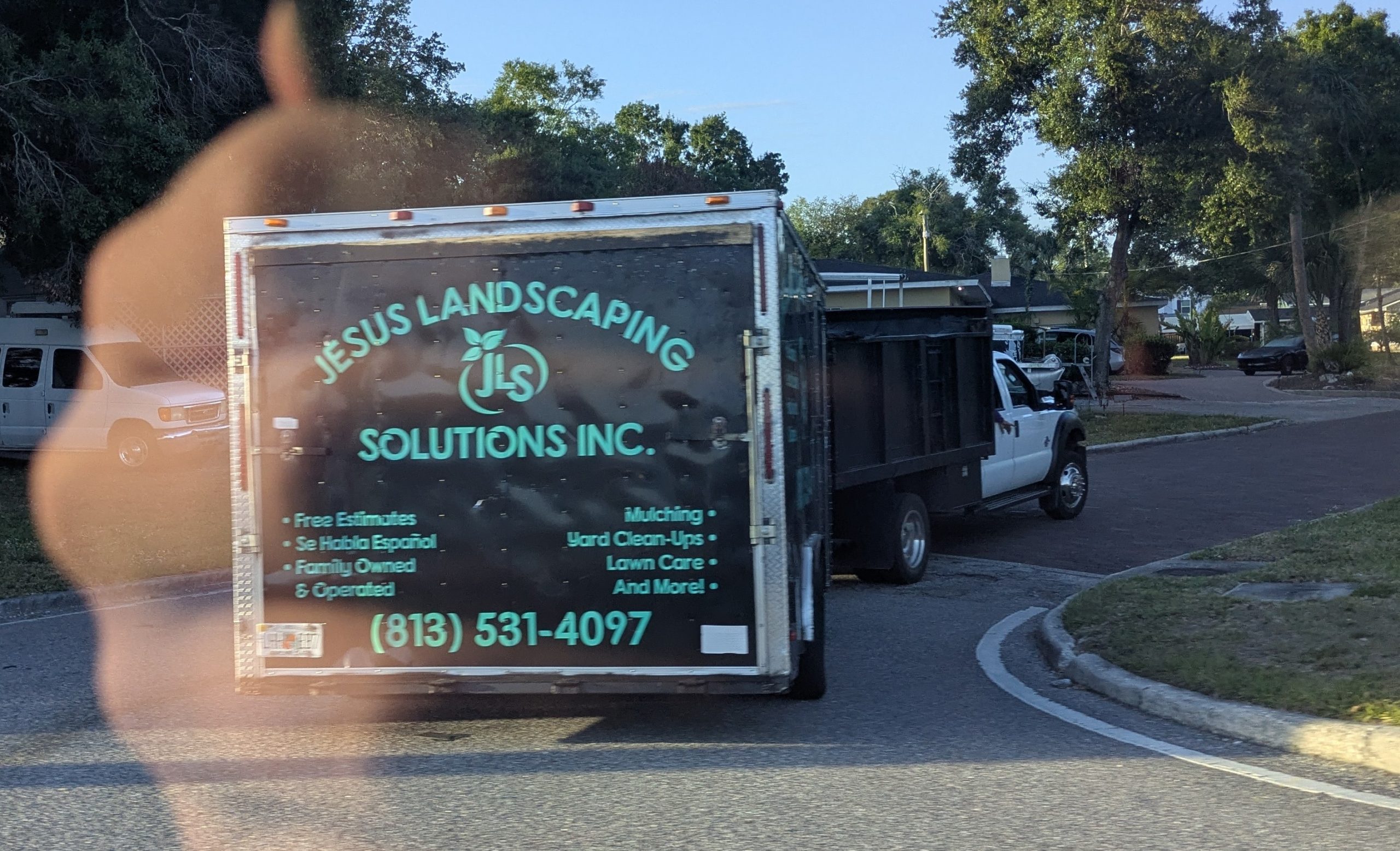
I was driving my son to school this morning when we saw something that made me laugh. A truck pulling a trailer. On the trailer, in big letters: “Jesus Landscaping.”
I couldn’t help myself. “I’d love to have Jesus come landscape my yard,” I said. Without missing a beat, my son replied:
“I’d rather have ‘He-sus.’ He-sus will actually do the work. Jesus will probably just try to convert me.”
That’s a pretty solid take for a high schooler. But it also raises a genuinely interesting question:
Does advertising your religion actually inspire trust?
Why Do Businesses Do This?
You see this kind of thing all the time:
- “Jesus Landscaping”
- “Christian Roofing”
- “Faith-Based Plumbing”
The idea behind it is pretty clear. Historically, religion has functioned as a signal of trust. If you were openly religious, especially in a largely religious society, it suggested: (a) you had moral constraints, (b) you were accountable to something higher, (c) you were less likely to cheat people. There’s no evidence any of that was actually true. But that was the intention of the signal.
In that context, putting “Jesus” in your company name wasn’t meant to be just branding. It was meant to be reassurance.
But That Signal Doesn’t Land the Same Way Anymore
We don’t live in that same context. The U.S. is more secular than it used to be. It’s also more religiously diverse and more politically polarized. Which means that the same signal now lands very differently depending on who’s reading it. For some people, “Jesus Landscaping” may still signal:
- trust
- shared values
- reliability
For others, it might signal:
- potential proselytizing
- political alignment
- allegiance to corrupt institutions
- hypocrisy
- or just… something they’d rather avoid
Of course, for a lot of people, it’s probably just noise.
Same Signal, Different Audiences
What’s interesting here is that nothing about the behavior has changed. The business owner is doing the same thing people have done for a long time: signaling identity to attract customers. What has changed is the audience. In a more pluralistic society, signals don’t have a single, shared meaning anymore.
They’re interpreted.
And sometimes, they backfire.
There’s Also a Bit of Irony Here
This is where things get a little more interesting. Because there’s a passage in the New Testament that speaks directly to this kind of thing. In Matthew 6:1, Jesus criticizes those who publicly emphasize their religiousness:
Be careful not to practice your righteousness in front of others to be seen by them. If you do, you will have no reward from your Father in heaven.
The critique is pretty clear: Don’t turn your faith into a public performance.
Now, I’m not saying putting “Jesus” on a landscaping trailer is the same thing as standing on a street corner praying loudly for attention. But it’s at least in the same neighborhood.
Okay, but… Does It Work?
Honestly, it probably still works—for some people. If you’re trying to attract a particular audience, religious branding might be effective. It might build trust within that group. It might generate loyalty.
But it’s not universally effective anymore. In fact, it may do the opposite for a growing segment of the population. There are many people who now associate religion with sexual abuse, corruption, and politics. Advertising your religion may have the opposite effect from what someone intends.
The Bigger Point
What I find most interesting about “Jesus Landscaping” isn’t whether it’s a good business strategy. It’s what it reveals about how trust works in a changing society. We used to have more shared signals. Now, those signals are fragmented. What once meant “trustworthy” now means different things to different people.
The Bottom Line
“Jesus Landscaping” is trying to communicate something simple:
“You can trust me.”
The problem is that the message doesn’t land the same way it used to. For some people, it may still work, whether it’s truth in advertising or not. For others, it raises questions.
And for at least one high schooler, it suggests you might get a sermon instead of your lawn mowed.