
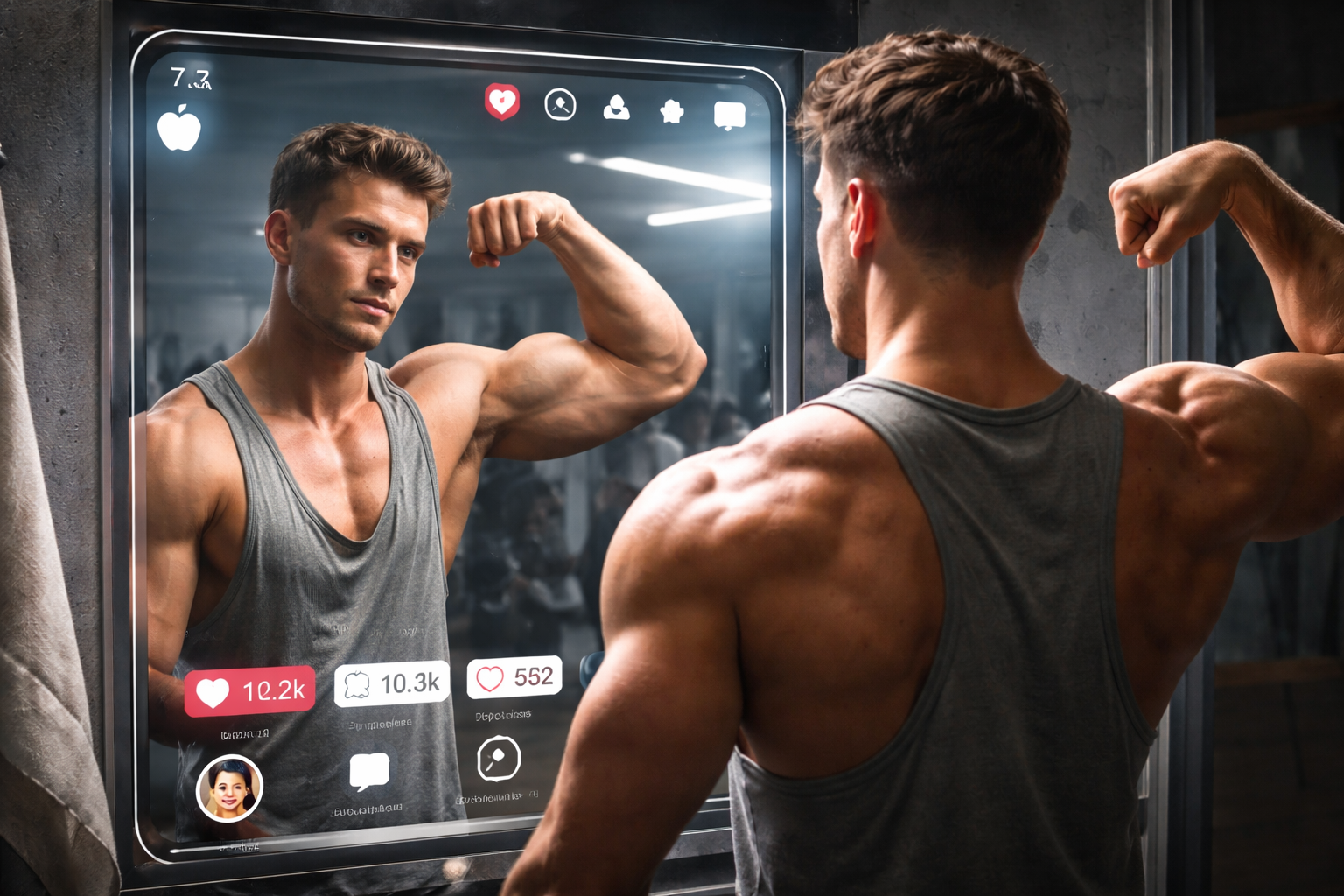
I work out almost every day. Mostly cardio—soccer, walking, stairs. Once a week I do a TRX/CrossFit class at my university. This past week, I was in the locker room changing before class when something kind of strange happened. Over the course of about ten minutes, five different guys came in after their workouts, took off their shirts, and stood in front of the mirror flexing.
No conversation.
No interaction.
They knew I was standing right there. It didn’t matter. Every once in a while, one of them would say something quietly to himself—“Yeah, that’s good,” or “That looks right”—but that was it. It wasn’t social. It wasn’t performative for others.
It felt… ritualistic.
And it got me thinking…
This Wasn’t About Me
At first glance, it’s easy to read something like this as vanity. And sure, vanity probably plays some role. But that’s too simple—and honestly, too easy. What struck me wasn’t that they were showing off.
It’s that they weren’t.
They weren’t talking to me, even non-verbally. For all intents and purposes, I wasn’t there. I didn’t exist. I was NOT the audience.
They weren’t trying to impress anyone in the room. They were standing in front of the mirror, evaluating themselves against… something.
An internal standard?!?
The Mirror Isn’t Just a Mirror Anymore
If I had to sum up what I saw in one sentence, it would be this:
The locker room mirror has become a kind of offline version of social media.
Think about it:
- Mirror → Instagram feed
- Flexing → posting
- Self-talk → captions/likes
- Silence → the audience doesn’t matter anymore
They weren’t performing for me. They were performing for an internalized audience—a mental version of what “looks good” that’s been shaped somewhere else.
Enter “Looksmaxxing”
There’s actually a term for this online: Looksmaxxing. At its core, looksmaxxing is the idea that your appearance is something you should systematically optimize:
- Build muscle
- Reduce body fat
- Improve grooming
- Dial in aesthetics
And underlying all of that is a simple assumption: How you look is a primary measure of your value.
Now, to be clear, I’m not saying the guys in the locker room are part of some niche internet subculture. They probably aren’t. What’s interesting is that you don’t need to be in that corner of the internet to see the same logic playing out. It’s already mainstream.
From Function to Aesthetics
Fitness didn’t used to look like this. Historically, physical fitness was about: strength, endurance, capability, survival, even.
Now?
It’s increasingly about: Appearance!
That doesn’t mean health has disappeared. But it does mean that: What your body looks like has become more important than what your body can do.
And appearance has a big advantage:
- It’s immediate
- It’s visible
- It’s comparable
Health isn’t.
The Body as a Project
There’s something deeper going on here. For a lot of people—especially younger men—the body has become a project. It’s something you can control. It’s something you can improve. It’s something you can measure
In a world where careers are uncertain, identities are fluid, and traditional milestones are delayed, the body is one of the few things that feels fully within your control.
So you optimize it. You refine it. You evaluate it. Over and over again.
Why This Feels New (Even If It Isn’t)
To be clear, this isn’t entirely new. Humans have always cared about appearance. Vanity is not a 21st-century invention. What’s different now is the feedback loop. Social media has created a world where:
- You are constantly visible (or potentially visible)
- You are constantly comparable
- You are constantly evaluated
Even when no one else is watching. That’s the key shift. The audience has been internalized.
Is This a Problem?
I don’t think the answer is simply “yes” or “no.”
If focusing on aesthetics gets people into the gym, that’s probably good. Many people who start working out for how they look end up healthier.
But…
When appearance becomes the dominant goal, it can distort priorities. Health, function, and well-being can become secondary. Self-worth can become tied to visual standards that are… not always realistic
So it’s not that this is inherently bad.
It’s that it is becoming dominant and normative.
Should we be worried about that?
What I Actually Saw
Looking back, what struck me most wasn’t the flexing itself. It was the silence. Five different people. Same behavior. No interaction. Each one standing in front of a mirror, running the same internal evaluation:
“Does this look right?”
That’s not just vanity. That’s a cultural script.
The Bigger Point
We tend to think of social media as something that happens on our phones. But increasingly, it doesn’t stop there. It shapes how we see ourselves, evaluate ourselves, and even move through physical space.
The mirror in the locker room isn’t just reflecting a body anymore. It’s reflecting a standard. And more often than not, that standard isn’t coming from the person in front of it.
The Bottom Line
I’m not particularly interested in criticizing the guys in the locker room. They’re doing what makes sense in the world they’re in.
What’s more interesting is the world itself. Because if five people can independently walk into a room, say nothing, and perform the same ritual of self-evaluation…
…it probably isn’t about them.
It’s about us.