
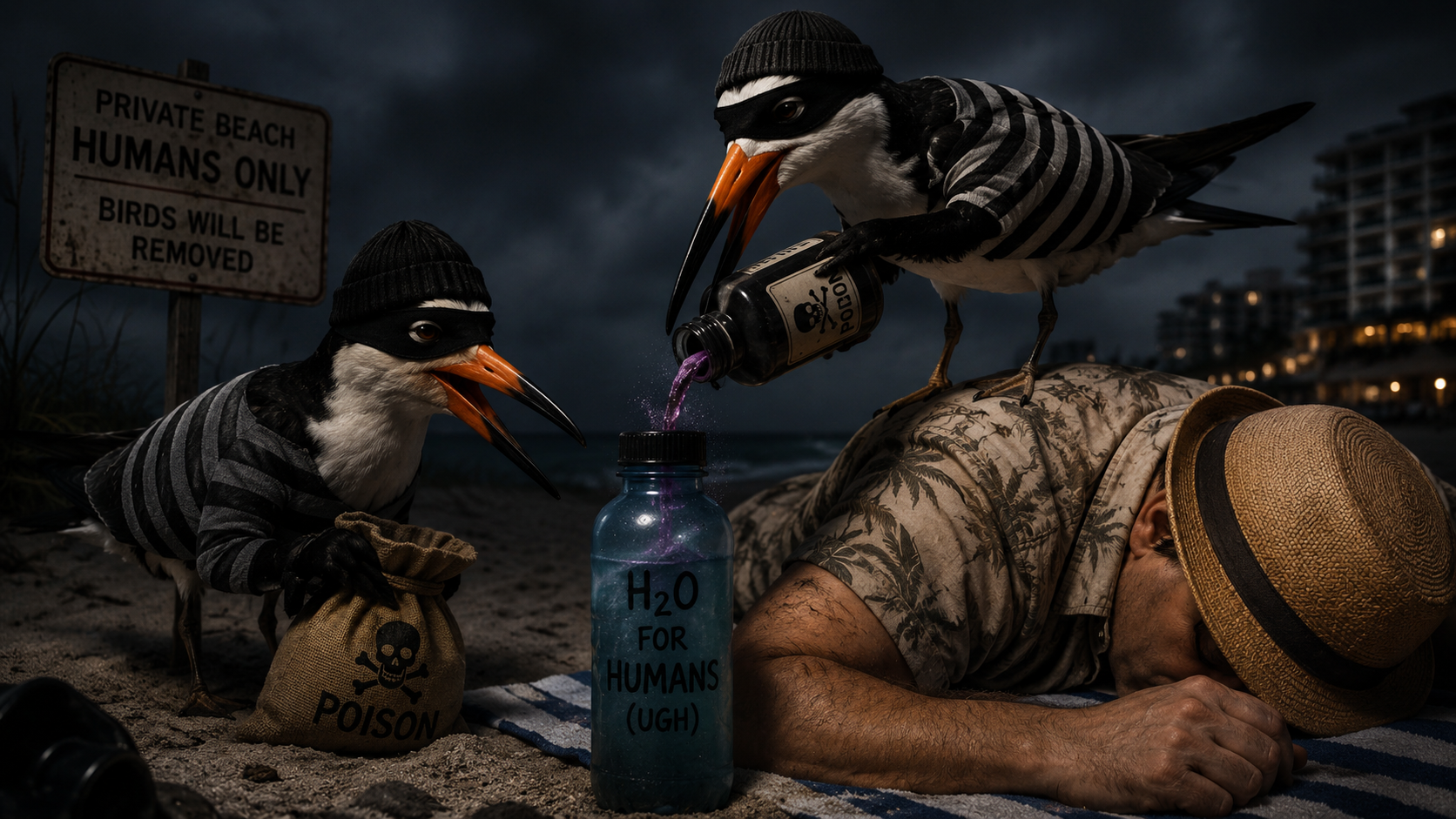
They arrive in numbers.
They take over the shoreline. They build enormous structures where there used to be open sand. They bring machines, lights, noise, vehicles, garbage, chemicals, and crowds. They reshape the dunes, clear vegetation, and carve up the coast according to their own needs. When other species get in the way, they fence them out, chase them off, poison them, or simply destroy the places they live.
They are, frankly, a nuisance.
The nuisance to which I’m referring here is us. Humans. We are the greatest nuisance to other species at present.
But we almost never tell the story that way.
My colleague Doug Ezzy is fond of asking, “What matters to wombats?” It is a deceptively simple question. We spend nearly all of our time asking what matters to humans. What do we want? What makes our lives easier? What maximizes our comfort, our property values, our profits? Other living things enter the equation largely in relation to us: Are they useful? Beautiful? Dangerous? Delicious? Annoying?
But what matters to them?
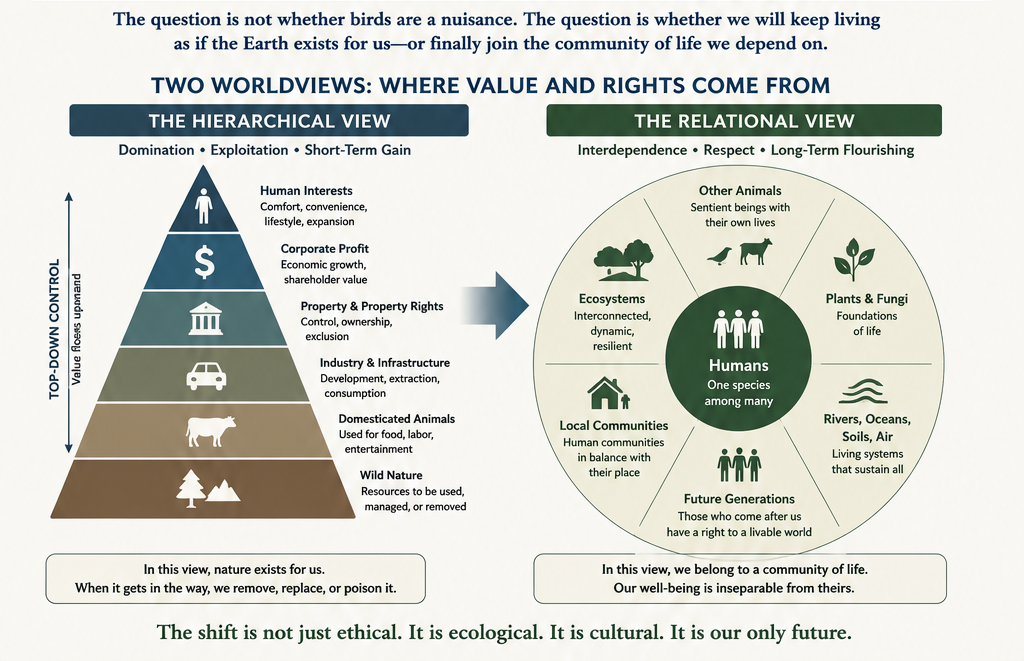
I have been thinking a lot about this question because I am currently working on a book with Doug and Lori Beaman about changing relationships among humans, nature, and other-than-human animals. Part of what we are exploring is a subtle cultural shift in which at least some people are moving away from a strictly hierarchical understanding of life—humans at the top, everything else below us—and toward a view that grants other living beings much greater moral standing.
Then I opened the Tampa Bay Times today and encountered almost the perfect illustration of the opposite worldview.
According to Florida wildlife officials, two men were arrested after an investigation into roughly 1,500 mothballs scattered on St. Pete Beach in April near a colony of black skimmers, a state-designated threatened species. Investigators allege that the men wanted to prevent the birds from nesting behind businesses on the beach. Text messages obtained by investigators reportedly discussed the problem: if the birds nested there, the “bird people” would put up fencing.
So, allegedly, the solution was mothballs.
There is something almost breathtaking about the moral hierarchy embedded in that logic.
- We built the hotel.
- We operate the business.
- We want unrestricted access to the beach.
- The birds might interfere with that.
- Therefore, the birds need to go.
To be clear, wildlife really can create problems for humans. Animals damage crops. Predators kill livestock. Birds nest in inconvenient places. Protecting habitat can constrain development and cost people money. A more egalitarian relationship with other species does not require pretending that humans and wildlife never have conflicting interests.
But conflicting interests require weighing interests. And that is the part we have historically been remarkably bad at doing.
For much of human history—and especially through modern industrial capitalism—the default assumption has been that human interests win. More specifically, certain human interests win: development, ownership, convenience, consumption, and profit. The interests of other living things receive consideration primarily when humans decide they should.
That worldview is so deeply embedded that we even have a revealing word for animals that interfere with our plans: nuisance.
Consider the black skimmers.
They are birds trying to reproduce on a beach. That is not aberrant behavior. That is what black skimmers do. Yet much of Florida’s coastline has been transformed for human purposes. We have built condominiums, hotels, restaurants, roads, parking lots, seawalls, swimming pools, and tourist destinations along the places where coastal species have lived and reproduced for millennia.
Then, when wildlife persists in using those spaces, we sometimes regard the wildlife as the intrusion. From the skimmers’ perspective, the story probably looks quite different.
Which brings me back to Doug’s wombats. “What matters to wombats?” does not require believing that wombats—or skimmers—are identical to humans. It asks us to perform a moral exercise that humans rarely perform: briefly step outside our own interests and consider the world from the perspective of another living being.
A skimmer presumably has no concept of property law, tourism revenue, beachfront real estate, or quarterly profits. But it has interests. It needs food. It needs habitat. It needs a place to reproduce. It responds to threats. Its continued existence depends upon conditions that humans increasingly control.
Those interests do not automatically outweigh ours. But neither should ours automatically outweigh theirs. That is the shift I think we need.
The two men arrested in St. Pete Beach—assuming the allegations are borne out—represent an extreme end of an old spectrum: nature exists for us, and when it interferes with what we want, we remove it.
Most of us would never scatter mothballs around threatened birds. But the worldview underlying that act is far less unusual than the act itself. We clear forests for development, drain wetlands, pave habitat, poison unwanted species, and alter ecosystems on an enormous scale, typically because doing so benefits humans economically or makes our lives more convenient.
We cannot keep doing that indefinitely. A finite planet cannot sustain a species that treats every other form of life as subordinate to its immediate desires. Eventually, a civilization organized around extraction, expansion, and short-term profit consumes the ecological systems on which that civilization itself depends.
Moving forward does not require putting birds above people. It requires getting rid of the assumption that people are always above birds. Perhaps the first step is simply learning to ask a different question.
Not just: What do we want from this beach?
But: What matters to skimmers?