
My wife recently received the following text from an unknown number (813-296-6503):
“Hey, this is your neighbor. Did you see this article came out about Luis Salazar who’s running for office in our district?”
The message linked to an opinion piece attacking Salazar and ended with two more words:
“That’s crazy.”
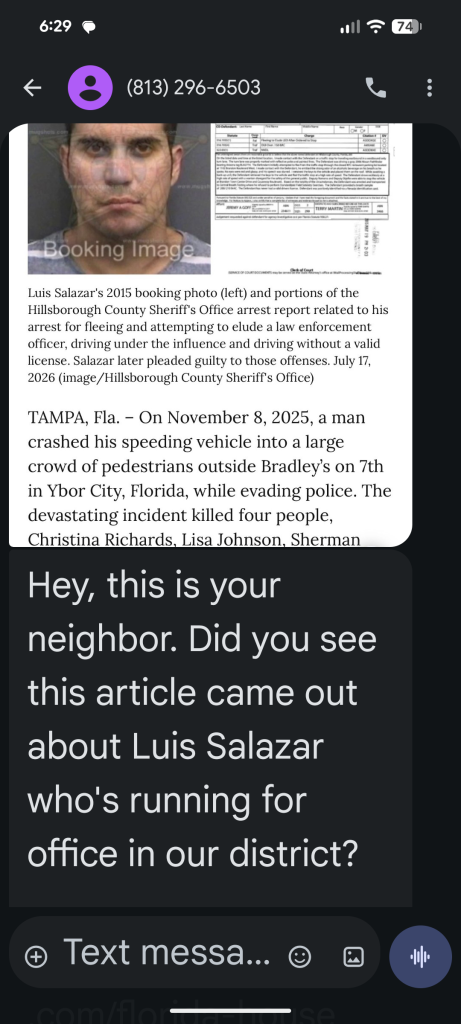
The sender did not provide a name. They did not identify our neighborhood, explain how they knew my wife, or say who had paid for the message. They wanted the credibility of being “your neighbor” without the accountability of being anyone in particular.
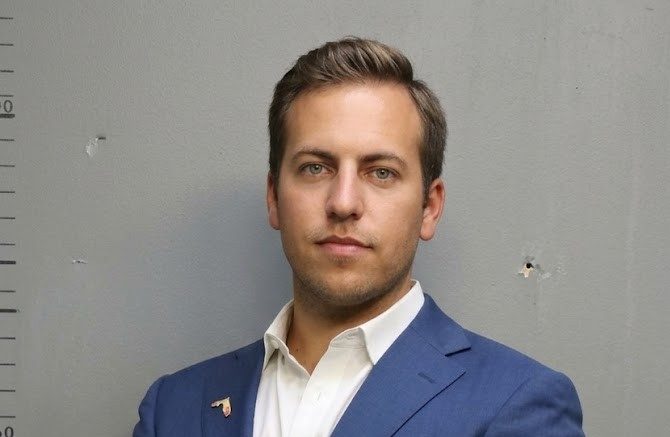
The article was written by Jake Hoffman, an active Republican operative. Hoffman’s old campaign website describes him as a Republican candidate for the Florida House, although official records show that campaign ended in defeat in 2022. He currently serves as executive director of the Tampa Bay Young Republicans, an organization devoted to advancing Republican principles and electing candidates who represent them.
That raises an obvious question: Why is a prominent Republican activist intervening in a Democratic primary?
Hoffman is entitled to criticize any candidate he chooses. Republicans also have an understandable strategic interest in whom Democrats nominate. They may prefer to face one candidate rather than another. They may want to weaken a likely nominee before the general election. Or they may simply enjoy creating conflict among Democrats.
But Hoffman’s article does not acknowledge that partisan context. It presents itself as a public-safety intervention and calls upon Salazar to withdraw while demanding that Democratic and LGBTQ+ organizations cut ties with him. The author’s Republican role appears only at the bottom.
(As a side note, Florida’s Voice, which published Hoffman’s hit piece, has made it pretty clear they are not a legitimate news website by publishing this drivel. Calling their employees “reporters” does not make them reporters.)
The anonymous text raises a separate and potentially more serious issue.
Florida law generally requires a text supporting or opposing a candidate to say “Paid for by” and identify its sponsor, or to link to a page containing that disclosure. There is an exemption when an unpaid individual personally sends a text without using mass-distribution technology. Messages that recipients expressly opted into are also exempt. A willful violation is a first-degree misdemeanor.
My wife did not opt into this message. It contained no sponsorship disclosure. The linked article identified Hoffman as its author, but it did not contain the statutory “Paid for by” disclosure for the text campaign.
Perhaps one unusually secretive neighbor manually sent this message to my wife and no one else. That is possible.
But the wording looks scripted. “Hey, this is your neighbor” creates artificial intimacy. “Did you see this article?” disguises political persuasion as casual information-sharing. “That’s crazy” tells the recipient how to feel while preserving the performance of an ordinary person spontaneously reacting to the news.
If this was part of a paid political operation—or if it was distributed using a political texting platform—it appears to fall outside the individual-sender exemption. Whoever organized it may have violated Florida law.
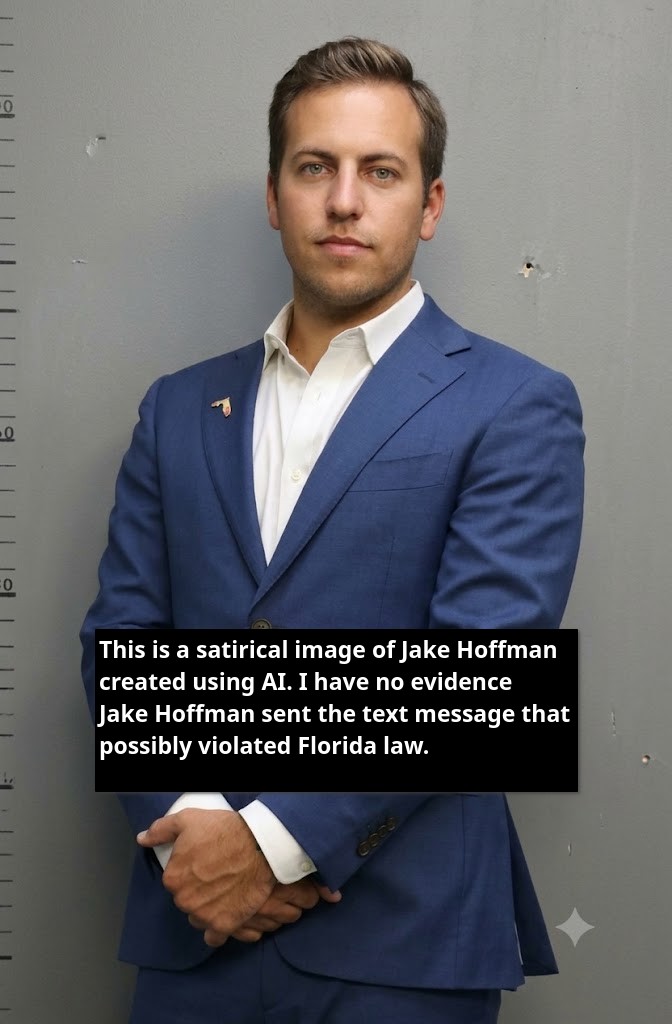
We do not know who sent it. There is presently no evidence that Hoffman sent it, paid for it, or knew about it. The same is true of Salazar’s Democratic opponents and every political organization that might benefit from the attack.
But if investigators identify the sender and establish that this was a willful violation, the responsible person should be prosecuted. Disclosure laws are meaningless if political actors can evade them simply by pretending to be nameless neighbors.
The ugliest part of the episode, however, is the psychology of Hoffman’s article.
Salazar’s 2015 conduct was serious. According to the records reproduced in the article, he pleaded guilty after driving intoxicated, fleeing a traffic stop and driving without a valid license. Voters are entitled to consider that information.
But Hoffman does not begin with Salazar’s arrest. He begins with the horrific November 2025 crash outside Bradley’s on 7th in Ybor City, in which another driver killed four people and injured 13. Only after describing those deaths and invoking the grief of Tampa’s LGBTQ+ community does Hoffman introduce Salazar’s decade-old case.
There is no meaningful connection between the two events. Salazar did not cause the Ybor crash. He had no apparent connection to its driver or victims. His offense occurred ten years earlier and did not result in anyone’s death.
The connection is emotional rather than logical.
Psychologists use the term evaluative conditioning for the way an object or person can acquire negative associations by being paired with something already frightening or repellent. The affect heuristic similarly describes how feelings such as fear, anger, and disgust can shape judgments of danger before careful analysis begins.
Hoffman borrows the emotional force of four deaths and attaches it to Salazar. He even accuses Salazar of having placed Tampa in “the same danger” and dismisses his condolences to the victims as “crocodile tears.”
The DUI is real. The equivalence is manufactured.
Voters should scrutinize Salazar’s record. They should also scrutinize political operatives who exploit an unrelated tragedy, anonymous senders who impersonate their neighbors, and anyone who believes election laws apply only when breaking them becomes inconvenient.
“That’s crazy,” indeed.
(NOTE: As of the day I am posting this, I have not decided who I am voting for in the primary election. I was not asked to write this post on behalf of Salazar and have had no contact with him or anyone on his team other than the flyer that was sent to my house recently. I’m just annoyed that someone sent a likely illegal text message to my wife and that someone would be so slimy as to write a political hit piece that tries to link a candidate to a horrific incident to which he has no connection. Shame on Jake Hoffman if he actually wrote that piece. And shame on whoever is illegally sending text messages to my wife.)