
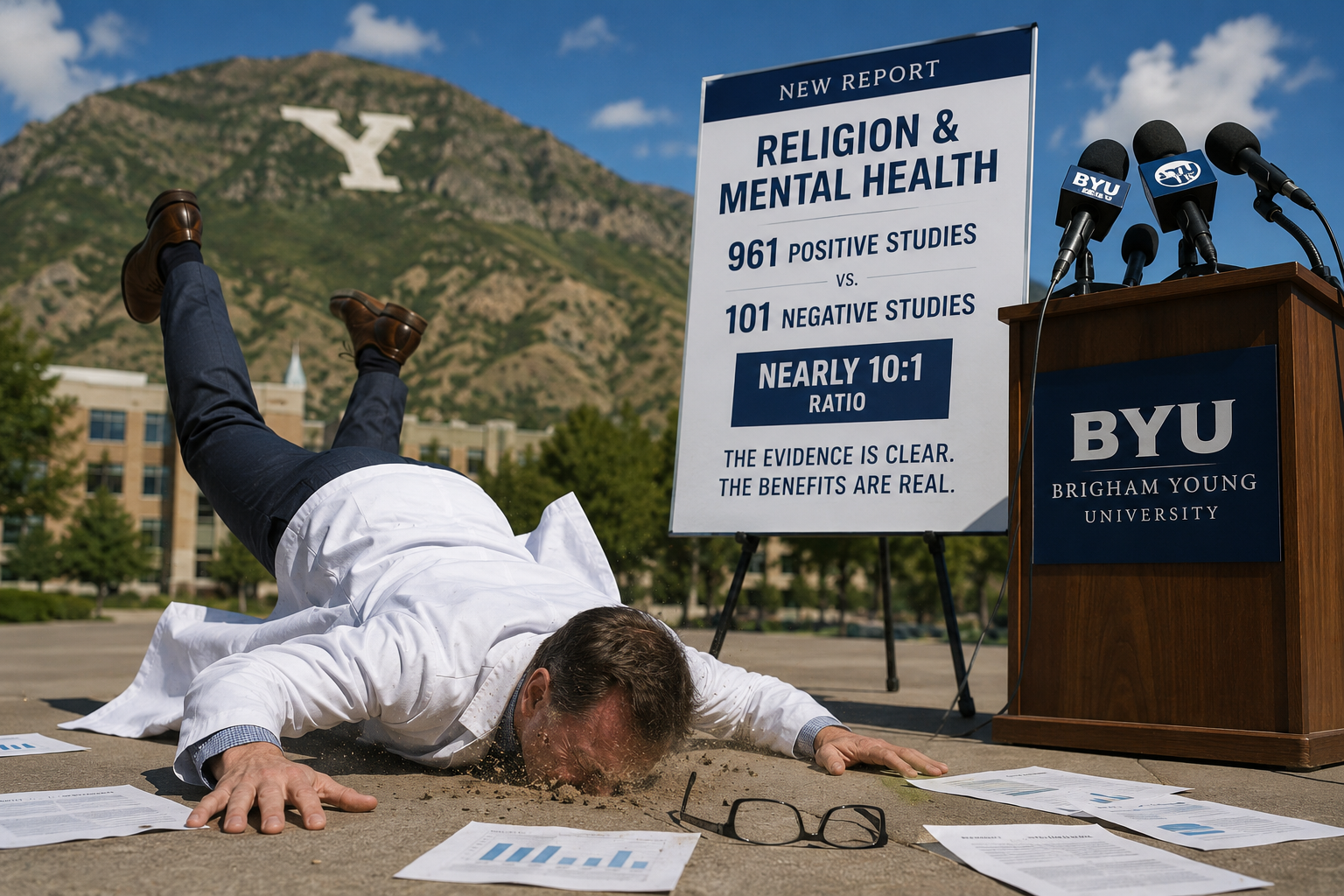
I will read the Wheatley Institute’s new report on religion and mental health. I really will. But I have to admit: they are off to a terrible start.
Before I even open the full report, the promotional page makes a claim so scientifically careless that it immediately undermines my confidence in what follows. The page proudly announces that studies reporting positive associations between religion and mental health outnumber studies reporting negative associations by nearly 10 to 1.
“Studies reporting positive associations between religious involvement and mental health (961) outnumber those reporting negative associations (101) by nearly 10:1.”
That sounds impressive.
It is also not how science works.
Imagine I found 961 poorly designed studies claiming the Earth is flat and 101 high-quality studies concluding it is round. Would the reasonable conclusion be: “Flat-earth studies outnumber globe-earth studies nearly 10 to 1”?
Of course not.
The correct conclusion would be: “Why are we counting garbage?”
Science is not determined by majority vote. Studies do not each get one ballot. A literature review is not a democratic election where every paper counts equally regardless of quality. And yet this kind of “vote counting” appears constantly in public discussions of science, especially in areas where people have strong ideological or cultural motivations to reach a preferred conclusion.
The problem is simple: not all studies are equally good.
If one study uses:
- a massive representative sample,
- longitudinal data,
- strong controls,
- validated measures,
- preregistration,
- and careful causal reasoning,
while another uses:
- a convenience sample of undergraduates,
- weak measures,
- cross-sectional correlations,
- inadequate controls,
- and questionable statistical decisions,
those two studies should not be treated as equivalent units of evidence simply because both resulted in a published paper.
But that is exactly what vote counting does.
This matters enormously in religion-and-mental-health research because the field contains a tremendous amount of methodological variability. Some studies are careful and sophisticated. Others are mediocre at best (I’ll return to publication bias in a later post). Many are cross-sectional and therefore struggle with problems of causation and selection effects.
For example, suppose religious people report lower depression levels. Assuming that is true in a specific study, the bigger question is: Why?
Is it:
- religious belief itself?
- social support?
- marriage?
- community integration?
- lower substance use?
- optimism?
- socioeconomic stability?
- personality differences?
- healthier people being more likely to remain involved in communities?
Those are very different explanations.
A huge amount of religion-and-health research cannot disentangle them cleanly. That does not make the entire literature worthless. It simply means the evidence has to be weighed carefully rather than counted mechanically.
And this is where the Wheatley Institute’s framing becomes scientifically misleading.
When a public-facing summary says there are “961 positive studies versus 101 negative studies,” the obvious implication to ordinary readers is that the scientific evidence overwhelmingly favors one conclusion. But that is not necessarily true at all.
A thousand weak studies do not outweigh a handful of exceptionally strong ones.
If anything, an obsession with counting studies often signals weakness rather than strength. When someone leads with, “Look how many papers support our position,” my first instinct is not confidence. It is suspicion.
Why are we counting studies instead of evaluating them?
Why are weak papers being placed on the same level as strong papers?
Why is the unit of analysis “published article” rather than “quality of evidence”?
This is especially important because publication itself is not a guarantee of reliability. Entire fields can drift toward publication bias, ideological conformity, weak methods, p-hacking, or low replication rates. A paper existing in a journal does not magically transform it into strong evidence.
Again, I have not yet reviewed the Wheatley report itself. Perhaps the full report is much more nuanced than its promotional materials suggest. I hope so.
But the front door to the report is a methodological faceplant.
If the Wheatley Institute wants to argue that religion improves mental health, then it needs to demonstrate that the strongest and most rigorous evidence supports that conclusion. That is a perfectly legitimate scientific argument to try to make.
But “our side has more studies” is not a serious way to establish scientific credibility.
That is not evidence synthesis.
It is scoreboard science.
One thought on “No, Science Is Not Decided by Counting Studies”
Comments are closed.