
We were driving through the Lithuanian countryside on our way back from visiting Aukštojas Hill, the highest point in elevation in Lithuania when he said it, “One day you’ll come back to believing in god.” I had spent the previous week in Kaunas attending a conference on the social science of religion. A close friend who was also traveling to Europe for work suggested we meet up after my conference to tour around the Baltic countries for a few days. Our conversation in the rental car had wandered on to the topic of religion. My friend isn’t particularly religious, though he does attend a nondenominational church with his wife at times. He also isn’t sure if he believes in a god or what the god he believes in at times is like. I’m an agnostic atheist: I don’t believe but I also recognize that, depending on the deity and how it is defined, we likely cannot know whether that deity exists. When I told him I don’t believe, his response surprised me. Later that night, when we met up for dinner, he mentioned that he had talked with his wife and she wanted him to tell me that she was praying for me.
Both of these actions – telling me that I’ll believe again and that someone is praying for me – seem benevolent. I genuinely believe that my friend and his wife did this out of love and concern. This is sincerely held belief. It is well-intentioned belief. But it is also a veneer on a hierarchical way of thinking: because I do not believe what they believe about the supernatural, I am inferior to them.
Importantly, when I say “inferior” here, I mean in a “moral worth” sense, which is the most fundamental form of value.
Am I of unequal moral worth?
When philosophers argue that any two humans are of equal moral worth, they include “moral” not because they are debating whether greed is good or bad. Morality is included because equivalence of humans has a moral component: if all people are equal, it is immoral to treat some as though they are lesser than others. Moral worth isn’t about morals, per se. It is about whether someone is considered equal to someone else at the foundational level. Are we true equals? Should my friend and I have equivalent rights? Am I morally lesser than my friend?
I believe my moral worth is the same as that of every other person on the planet – not higher or lower. At least, that’s what I believe, today. I didn’t always.
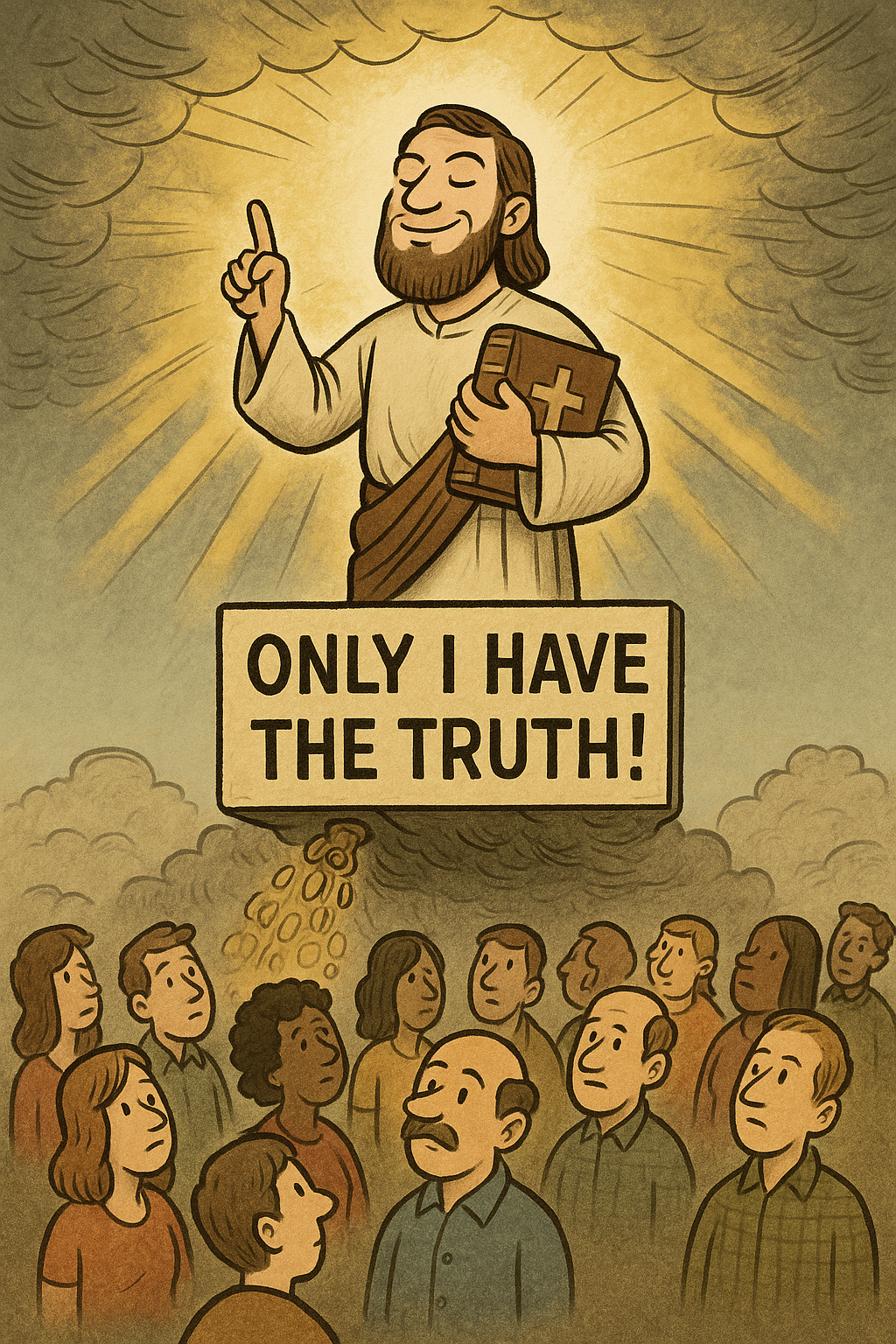
I spent two years in Costa Rica (1996-1998) as a missionary for The Church of Jesus Christ of Latter-day Saints; a.k.a. LDS or Mormon Church). While missions for the LDS Church serve a variety of purposes, at the core is the goal of converting people to the religion. The LDS Church is an exclusive religion, teaching that it, alone, has the truth that is sufficient to allow humans to obtain the highest postlife reward.
As a missionary, my primary goal was to convert people to the LDS Church. I was partly motivated by Mormon exclusivism: I believed I had the truth that would save them from a lesser eternity and I wanted them to have an opportunity to accept that truth. This motivation seems beneficent: I wanted to help people. But it’s a beneficence akin to assimilating indigenous populations or a physician performing a hysterectomy on a woman when she indicates she doesn’t want anymore kids without asking her. Those “helping” are doing so because they think they know better what the other person needs, whether the help is actually wanted or not and whether there is harm that results.
I kept a journal during my mission. Here’s an entry from March 25th, 1996, while I was in Cartago, “Oh how cursed are the souls of those who distort the truths of God. They are so simple. None of the other churches even know what it is they worship or believe.” The day I wrote that I was playing therapist for a suicidal 18-year-old and providing parenting advice to a 16-year-old mother of two.
I was 19.
I thought I was helping. Maybe I did help a person or two. But under that benevolence is a hierarchy of moral worth. A thought experiment will illustrate the moral worth hierarchy.
Imagine we have two people, Suzy and Doug. Suzy belongs to an exclusive religion—one that claims to be the only path to the ultimate reward: heaven, salvation, or some equivalent. She doesn’t just belong to this religion; she believes that her membership gives her access to a unique truth and, because of that truth, eligibility for this ultimate reward.
In her mind, this puts her in a special class of people: those who possess the truth and will receive the reward. Unless this class includes everyone, it necessarily excludes some. And those outside the class, by definition, will not receive what the insiders will. That’s a hierarchy: some people are seen as more deserving than others.
From Suzy’s perspective, wanting to share her religion may feel benevolent. She has something of ultimate value, and she wants others to have it too. But this desire is still rooted in the idea that she is already in a superior position—the position of someone who “has” what others “lack.”
Now enter Doug. Suzy approaches him with her offer: accept the truth she has embraced, and he too will join the special class and become eligible for the reward. Doug listens, but rejects her message. In Suzy’s belief system, that decision has consequences: Doug remains outside the class. His rejection—whatever his reasons—marks him as someone who will not receive the ultimate reward.
The distinction is now absolute: Suzy is in, Doug is out. One is eligible for the highest good their worldview can imagine; the other is not. Even if Suzy treats Doug kindly in everyday life, her worldview places them in different moral and spiritual categories. Which raises the uncomfortable question: in such a system, can Doug and Suzy truly be said to have equal moral worth?
What’s happening in Suzy’s worldview is more than a difference of opinion. It’s a moral architecture built around an ultimate hierarchy. The structure looks something like this:
- There is one ultimate good—call it heaven, salvation, enlightenment, exaltation.
- Only people who hold a specific set of beliefs are eligible to receive it.
- Suzy has those beliefs; Doug does not.
- Therefore, Suzy is in a superior ultimate position, and Doug is in an inferior one.
From inside the system, this hierarchy can be softened with words about wanting to help others, humility, and universal dignity. Suzy might insist that she values Doug as a person, that she sees them both as “sinners saved by grace” or “children” of the same god. But the logic is still there: in the final measure, her class receives the greatest possible good, and his does not.
That is what makes the question of moral equality unavoidable. If moral worth means that every person’s life, interests, and ultimate standing matter equally, then tying the ultimate good to membership in a particular class breaks that equality. It creates two kinds of people—those “in” and those “out”—and assigns them different ultimate destinies.
Even if the distinction is invisible in daily life, it’s always present in the background. It shapes the way insiders see outsiders, and it frames outreach—however benevolent it may feel—as an effort to move someone from an inferior to a superior category. That is why, to someone like Doug, Suzy’s offer can sound less like kindness and more like a reminder of where she believes he stands.
Let’s table the hierarchy of moral worth issue for a moment.
What if religion actually makes people better? If scientific research can demonstrate that religion makes people happier, healthier, more charitable, and more likely to help others, then this isn’t actually about moral worth. This would be about religion being a boon to societal harmony. Religion would be a net benefit to all of humanity by making humans more moral. If that is true, there is a different—arguably superior—justification for religious exclusivism: religion actually makes people better.
And what does the science say? Religious people are not happier than nonreligious people. Religion doesn’t make people physically or mentally healthier than those without religion. Religious people do give more money… to religions. But they do not give any more money than nonreligious people to secular charities. Religious people are no more likely to be civically engaged or volunteer than are nonreligious people. Religion is not a panacea that will solve the worlds’ ills.
You may have seen news articles or heard that religious people are better in all of these ways. That research exists, but is deeply flawed for two reasons. First, the researchers behind this likely examined dozens of datasets and relationships before finding one where there was a difference. They cherry-picked the data.
Second, they rarely or never report how big the differences are. This second point is important but rarely mentioned in news articles. Which is more important: that there is a high chance of rain or how much it is going to rain? If the forecast calls for a 95% chance of rain, that’s good to know. But .01 inches of rain is very different from 10 inches. I may or may not take an umbrella with me if the forecast calls for a .01 inch misting. I’ll be double-checking my emergency supplies if the forecast calls for 10 inches.
That some researchers occasionally find there are statistically significant differences in pro-social measures between religious and nonreligious individuals takes on a whole new light when you realize that the differences they are finding are on the order of .01 inch rain forecasts. When objectively examined, the scientific research does not suggest that religious people are “better” than nonreligious people in any of the ways that we might consider to be net benefits to society.
If religion does not make religious people better, than we are back to supernatural claims driving the hierarchy of moral worth. The only way that religion makes someone “better” is by leading those who are religious to believe they are deserving of a reward that those who are not like them will not receive.
This article isn’t about Mormon missionaries, really. It isn’t even just about proselytizing exclusive religions. This article is about any religious person who believes that, because they are religious, they are better than anyone who does not share their particular form of religion.
I get it. We all want to feel superior in some fashion. I want to believe I’m right and those who disagree with me are wrong. I don’t know anyone who lives their life believing they are wrong. About religion. About politics. About anything, really.
What we need, then, is something in between right and wrong: a recognition that others can disagree with us but that doesn’t put them in an inferior class of people. What if, rather than looking down on those who don’t agree with us, we still see them as equals, at least when it comes to moral worth. We don’t have to agree with them. But we also don’t have to judge or condemn them. Maybe you, like me, just want to live your life without regular insinuations that you are of inferior moral worth. The only way for you to live your life that way is to do the same: not marginalize those with whom you disagree.
How do we live our lives without constantly looking down on others? I call this hyper-egalitarianism: starting from the position that everyone is of equivalent moral worth. And we live it by talking to each other when we disagree instead of condemning each other. This doesn’t mean we put pundits across a table and let them yell. It means we take turns listening to each other and trying to understand each others’ perspectives.
How do we know when we’re succeeding? We don’t try to convert other people to be just like us. We can disagree. We should disagree. But why does everyone have to be just like you or me? What a boring world if everyone was the same.
Embrace being wrong.
When you’re genuinely and truly wrong and can admit it, then, hopefully, you’re smart enough to realize you’re wrong and change your mind. And that means you’re less wrong.
How should I respond to a friend, a colleague, a family member, a missionary, or a stranger who tries to convert me? Or even just insinuates that I am of less moral worth than they are because I do not share their beliefs?
I think the correct response is to ask them, rather forcefully: When did you become so arrogant as to think you have the truth and everyone else is wrong? Or, why do you think I am morally inferior to you?
And if they respond: “But I’m only trying to help you.”
The obvious retort is, “Only people who think they are above others can reach down to help those beneath them.”
Or if they are offended when you confront them: “Why are you being so rude?”
“How is it rude to point out what you are doing but not rude to try to convert me to your way of thinking?”
Whether they think they are being benevolent or not doesn’t change the reality of what they are doing. Until those they are looking down upon others realize what they are doing, what motivation do they have to stop?