
A couple of days ago, I reviewed an article for one of the top journals in my sub-field: the sociology of religion. I’m not going to reveal the identities of the authors or even the primary arguments, but one of the claims in the paper is something I’ve been fighting for years now. I’ll probably write something formally about this in the future, but I figure I’ll put it into a blog post for now.
Here’s the claim:
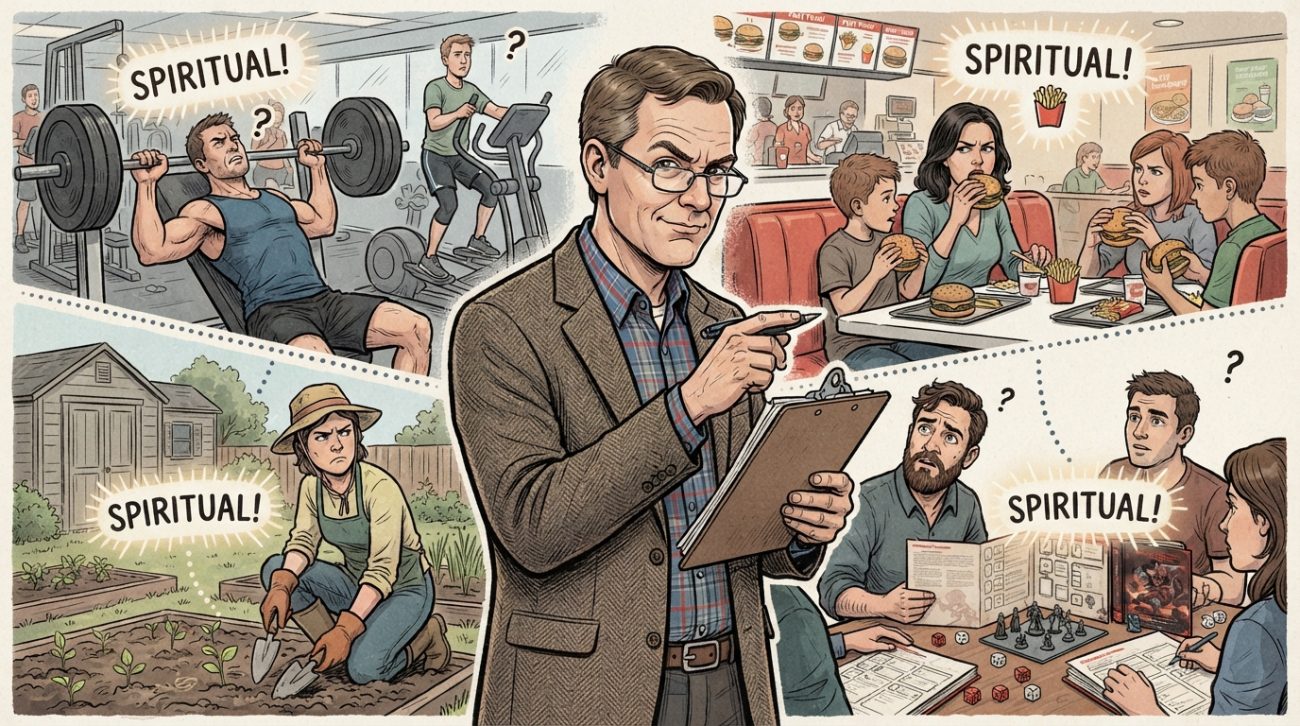
People who visit nature, listen to music, exercise, look inward or center oneself, practice yoga, and meditate are spiritual because those are spiritual activities.
Here’s the deal… I do all of those things every single day. I have a morning meditation that involves some yoga, music, and exercise that I do in my lanai, which allows me to view/visit nature. I do the meditation so I can look inward and center myself every morning. Additionally, I allot time to more formally exercise every day. I also love to hike and do so whenever I can (in nature). And, if I’m sitting at my computer, I’m listening to music (I’m listening to music as I write this).
Some reading this will say, “Well, Ryan, I hate to break it to you, but that means you are spiritual.”
And to those people I say, “Fuck you. No I’m not.”
I grew up a very devout Mormon. Most of my relatives are still members of the LDS Church. When I say I was devout, I really mean it. I took the religion seriously and did everything I could to follow the rules, policies, practices, and teachings of the religion. I believed the doctrines. I was very serious about it. Hell, I spent two years as a Mormon missionary in Costa Rica. That is devotion.
We didn’t talk much about spirituality back then (I can say “back then” now; I’m nearly 50). We did talk about “The Spirit” or “The Holy Ghost.” And I was taught that I could “feel the spirit.” In hindsight, I now realize that was just me experiencing emotions and feelings, which were often induced by specific circumstances or contexts (in my more cynical moments, I think of this as emotional manipulation). Those emotions were “hijacked” as “the spirit.” Fine. Call them what you want. They are emotions. I still have emotional experiences, but it sure as hell isn’t the Holy Ghost doing it!
I know what traditional, organized religion looks and feels like because it was my life until I was 26. In graduate school, I left the LDS Church. I briefly explored a couple of other religions, then decided religion, broadly, was not for me. Today, I am NOT religious. I have no religious affiliation (unless you include my membership in The Satanic Temple).
And, because I grew up religious and have a pretty clear sense of what religion is, I link spirituality with the supernatural. In order for something to be “spiritual,” I have argued in my research that it must go beyond the natural world and have some intended connection to something that is above or beyond nature, whether it is a higher power or a clearly defined deity. I do this for two reasons. First, the word “spirituality” has the word “spirit” at the root. Remember my upbringing. If I’m dealing with “The Spirit,” I’m dealing with something supernatural (though see the footnote at the bottom of this post). “Spirit” is not something science can sense, measure, or detect. Ergo, it’s supernatural. Spirituality must, therefore, involve the supernatural. Second, if we don’t define our terms, spirituality can literally mean anything.
I ate a great meal at KFC.
Spiritual experience!
I took a huge shit and enjoyed it!
Spiritual experience!
I beat my wife and kids and felt emotional doing it.
Spiritual experience!
I killed a puppy and felt powerful taking a life.
Spiritual experience!
Hell, one could argue the rush Dexter gets when he kills someone in the TV show Dexter is a spiritual experience.
I don’t identify as a critical sociologist, though some of my work probably comes close to fitting within that approach. Despite not being a huge fan of critical sociology, I don’t entirely disagree with some of the points that are often made. As relates to spirituality, I’m going to put on a critical sociologist’s hat for a moment. When scholars and non-scholars assert that someone like me, who clearly and intentionally identifies as neither religious nor spiritual, is either of those things, they are being imperialistic, hegemonic, and condescending. They are demanding that I concede my self-definitions to their understanding of what religion and spirituality are. That is imperialistic. They are asserting that everyone must be religious and spiritual. That is hegemonic. And they are arguing that I don’t understand myself well enough to know whether I am spiritual or religious. That is condescending.
Ergo, fuck those people.
To be as fair as possible, there are times when emic and etic categorizations can conflict. If I insist that I’m not a political conservative but I oppose abortion, oppose big government, want fewer taxes, want a strong military, favor military intervention internationally, and so on, I think it is fair for a scholar to say that my emic categorization (how I view myself) may not align with their etic (how the scholar views me) categorization. That can, does, and should happen. But, and this is key, I think a good scholar will: (a) recognize and admit what they are doing by rejecting my label, and (b) provide a compelling justification for why they are rejecting the emic categorization for their preferred etic categorization.
In the paper I reviewed, this emic/etic distinction was completely missing. They simply categorized anyone who did any of the things noted above – meditation, exercise, spending time in nature, etc. – as spiritual, regardless of how those people viewed the activities or self-identified. That is not good scholarship. That is imperialistic categorizing.
Okay. So, what’s my point?
I am taking to calling this “religiospiritual overreach,” which I define as: individuals who assert that beliefs, values, behaviors, or relationships that need not be religious or spiritual are, in fact, religious or spiritual.
There are lots of scholars and other people who can’t seem to allow people to NOT be spiritual or religious.
I first encountered this in the work on lived religion. I like the core lived religion idea: how people do their religion often deviates from official formulations of religion. Agreed. Great insight. But some of the scholars behind that methodological approach have argued that everything is (or at least can be) lived religion. The idea, and I’m not making this up, is that if someone could perceive an action as either religious or spiritual, whether the individual engaged in the action perceives it as such, then it is lived religion. One classic example is a woman gardening, which is framed as lived religion. From this perspective, if a researcher finds out that I do a morning meditation, they can then say I am doing lived religion, despite the fact that I am rejecting that label for my morning meditation. Thanks for forcing me into the very category I reject!
That is religiospiritual overreach!
One of my favorite examples of this religiospiritual overreach comes from a great study in 2012 looking at measures of spirituality by de Jager Meezenbroek et al. In that study, they were evaluating measures of spirituality and concluded that some of the measures were actually just capturing health, but then labeling that spirituality. Not surprisingly, when your measure of spirituality is actually a measure of health, when you use your fake measure of spirituality to predict health outcomes, it does! No one should be surprised when health predicts health. Circular logic and tautological reasoning, meet spirituality! This is a beautiful illustration of broadening spirituality to domains where it does not belong in order to force everyone into being spiritual.
That is religiospiritual overreach!
The most recent framework for this is “spiritual yearning.” The idea is that there are people out there who feel like something is missing from their life, whether it is meaning or purpose, a connection with something, or a desire for something else. I’m not denying that people may want all of those things. But what does that have to do with spirituality? If I find meaning in my family, supporting a sports team, or painting pictures, what does that have to do with spirituality? If I’m lonely and want connection, what does that have to do with spirituality? It is only “spiritual yearning” if hegemonic religiospiritual scholars try to dominate the discourse and force these HUMAN wants and desires into a religious or spiritual framework.
Religiospiritual overreach.
Why are they doing this? I don’t know. I’m not inside their heads. I don’t know their motivations.
I am inside my head (I guess). In my more cynical moments, I think this has to do with maintaining a fragile worldview. If your ego and worldview are so fragile that you have to force people into identities or categories or labels that they reject in order to convince yourself that your worldview is the right one, you have a problem. Well, you may have many problems. Why can’t you accept that other people don’t think, believe, or act as you do? Why can’t you accept other people’s self-definitions and self-understandings? Why can’t you let other people be who they are? Why are you being so imperialistic and forcing your labels on everyone else?
As a person who is neither religious nor spiritual, I am perfectly fine accepting that some people are religious and some people are spiritual. If that is how they want to self-identify, I will happily accept that. But I’m not going to put people who are strongly, forcefully, and intentionally NOT those things into the boxes they clearly, willfully, and intentionally reject. That is disrespectful to those people. It is shitty scholarship. And it needs to end.
(Footnote: I’m sure someone out there is thinking, “But “spirit” can also refer to something like the ‘human spirit.’” Yes. It can. But, when someone says, “That was a spiritual experience,” they are typically not referring to the ‘human spirit.’ I recognize that we get to define our terms. One of the core arguments of this post is that there are better and worse definitions of terms like spirituality. Not surprisingly, I think my definition is better than others! 😉