
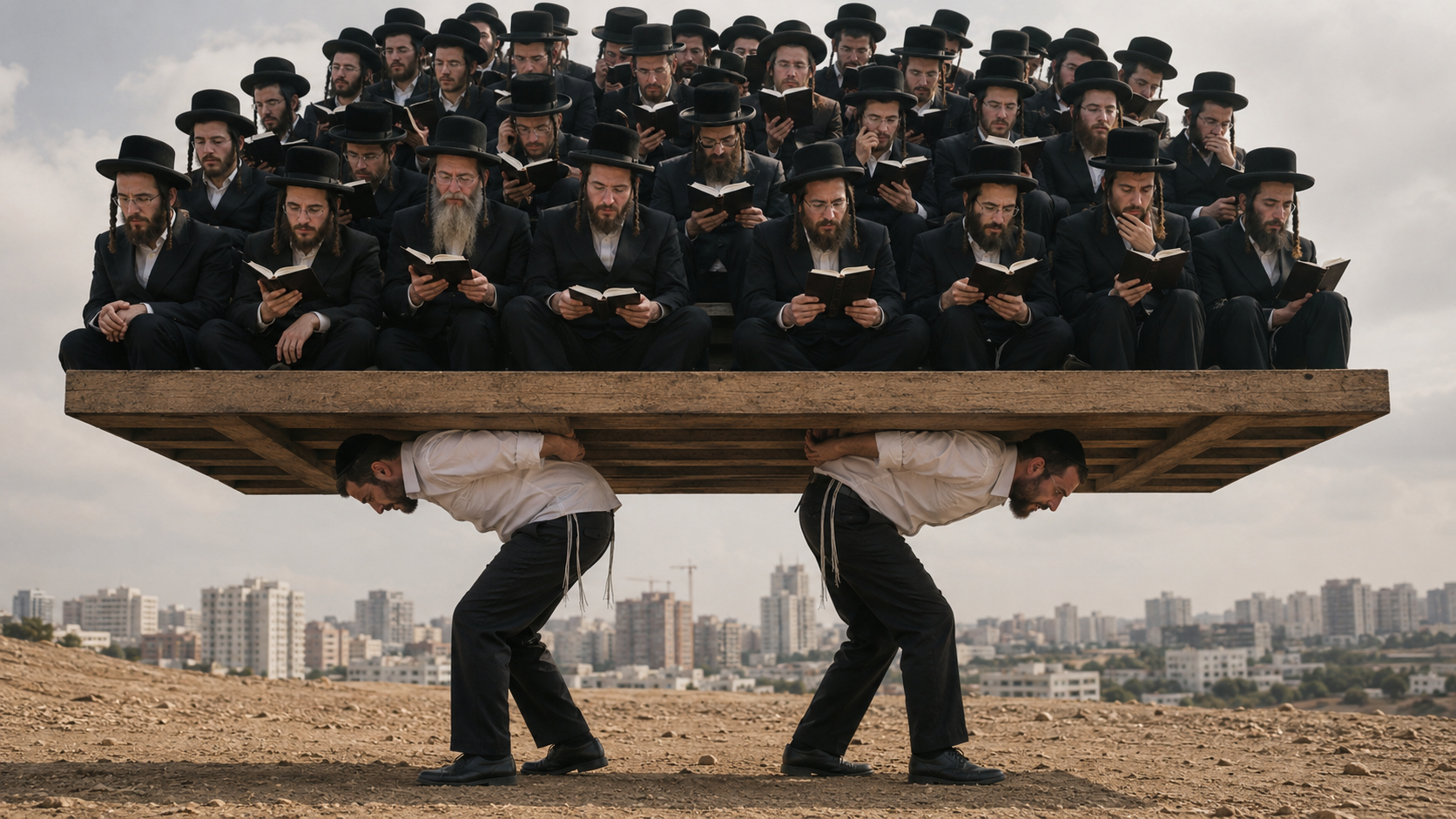
Every society supports people who do not work for pay. Children do not work. Retirees often do not work. Students may spend years preparing for future work. Parents may leave paid employment to care for children. Some people cannot work because of disability, illness, or age. Others devote themselves to art, public service, religious life, or unpaid community work.
So the question is not whether every person must always have a paid job. That would be a crude and ugly way to think about human life. The better question is this:
How large can a non-working population become before the burden placed on everyone else becomes unfair, unstable, or impossible to sustain?
That is the question I have been thinking about. I’ll come back to why below.
The example that brings this into sharp relief is Haredi, or ultra-Orthodox, Jewish society in Israel. But I want to be very clear from the beginning: this is not an argument that Haredi Judaism is bad. It is not an argument that Torah study has no value. It is not even an argument that religious communities should not be allowed to organize their lives around religious values. The issue is broader than Haredi Judaism.
The issue is what happens when a religious ideal becomes a public fiscal arrangement. What happens when a growing share of a society is encouraged, or at least allowed, to remain outside of paid employment while other people are expected to pay the taxes that support the state, fund services, maintain the military, and subsidize the religious study of those who are not working?
That is not just a religious question. It is a demographic and economic question.
The Israeli case
In Israel, Haredi Jews make up a growing share of the population. The Israel Democracy Institute estimates that the Haredi population was about 14.3% of Israel’s population in 2025. It also projects continued growth, with Haredim reaching about 16% of the population by 2030. Longer-term projections suggest the share could rise much higher by mid-century.
Assumptions: Haredi population share is anchored at 14.3% in 2025, 16% in 2030, and 32% in 2065. Values after 2065 are extrapolated using the same compound trend implied by the 2030–2065 change. This simplified estimate assumes that males make up 50% of the Haredi population and that 46% of Haredi men remain outside paid employment. Because the employment figure technically applies to adult men, this should be read as an illustrative burden scenario rather than a precise age-adjusted demographic estimate.
This growth is driven in large part by fertility. Haredi families in Israel have far more children, on average (~6.5 per woman), than other Jewish families (~2.2 per woman). That means the Haredi share of the population is likely to continue rising unless fertility patterns, retention patterns, or migration patterns change substantially.
Again, none of this is morally bad in itself. Having children is not wrong. Religious communities growing is not wrong. The question is what happens when demographic growth is paired with a social model in which many men are expected to devote themselves to full-time religious study rather than paid employment. This is where the Israeli case becomes especially important.
Haredi women in Israel often work. In fact, their employment rates are much closer to those of non-Haredi Jewish women. The distinctive issue is Haredi men. Haredi male employment has remained much lower than that of other Jewish men in Israel. Recent reports put Haredi male employment in the low-to-mid 50% range. That means roughly 45–50% of Haredi men are not in paid employment.
Many of those men are enrolled in yeshiva or kollel study. The Israel Democracy Institute reported that, at the beginning of 2024, there were about 169,000 yeshiva and kollel students in Israel. That number is not exactly the same thing as “unemployed Haredi men,” but it captures the scale of the full-time religious-study system.
And that system is subsidized by the state.
Not always directly as a comfortable salary to individual students. That would be too simple a description. But the state supports the system through yeshiva funding, stipends, education budgets, welfare structures, child allowances, housing supports, and other public policies. In other words, full-time religious study is not simply a private choice. It is embedded in a public funding structure.
That is where the fairness question begins.
A small arrangement can become a large problem
A society can easily support a small number of full-time religious scholars. Many societies have done this. Monks, priests, rabbis, scholars, and contemplatives have long existed alongside farmers, merchants, soldiers, workers, and taxpayers.
At small scale, this is not a serious problem. It may even be a source of cultural richness. But scale changes everything.
If 1% of a population withdraws from paid employment for religious study, the rest of society can probably absorb the cost. If 5% does so, the burden becomes more noticeable. If 10%, 15%, or 20% of the population is connected to a model in which large numbers of adult men do not work, the question becomes much more serious.
Who pays for the roads, hospitals, schools, pensions, defense, police, courts, and public infrastructure? Who serves in the military? Who pays the taxes? Who carries the debt?
And perhaps most importantly:
Why should some citizens be expected to support a religious lifestyle they do not share, while also bearing civic obligations that others avoid?
This is the core of the problem. It is not about whether Torah study is meaningful to those who practice it. It clearly is. The question is whether religious meaning for one group creates an unfair material burden for everyone else.
The burden is not theoretical
This is not just an abstract concern. Israeli economists and policy institutes have tried to estimate the cost.
The Israel Democracy Institute estimated that low Haredi workforce participation means non-Haredi workers pay thousands of shekels more in taxes each year than they otherwise would. Its estimate for 2025 was about NIS 3,540 more per non-Haredi worker. By 2048, assuming demographic and labor-market trends continue, that figure rises to more than NIS 11,000 per non-Haredi worker. In my simple extrapolation, if the Haredi population grows like the figure above suggests, that subsidy by non-Haredi worker eventually crosses NIS 60,000 per year (see figure below). Arguably, that is not a bearable amount.
This is a scenario model, not a prediction. It asks: if current demographic and labor-market patterns continue, how might the fiscal burden on non-Haredi workers change over time?
Assumptions: The fiscal burden model is anchored to Israel Democracy Institute estimates of NIS 3,540 per non-Haredi worker in 2025 and NIS 11,266 in 2048. After 2048, the burden is scaled according to the projected ratio of Haredim to non-Haredim. Figures are shown in nominal NIS-like scenario terms and should not be interpreted as inflation-adjusted forecasts.
That estimate is striking because it is limited. It focuses on direct labor taxes. It does not fully capture every possible cost: welfare transfers, lost productivity, lower GDP, military-service inequality, educational gaps, or the long-term effects of having a growing share of children educated in systems that may not prepare them for a modern labor market. So the real burden may be broader than the tax figure alone.
The OECD has also raised concerns about Israel’s long-term economic outlook if labor-market participation and educational outcomes among ultra-Orthodox men do not improve. Again, this is not anti-religious rhetoric. It is economic arithmetic.
Modern states need workers. They need taxpayers. They need people with math, language, technical, and professional skills. They need a broad enough tax base to support public spending.
If a rapidly growing sector of the population is less likely to enter the workforce, less likely to receive labor-market-oriented education, and more likely to rely on public subsidy, the state has a structural problem.
This is a "free-rider" problem
In social-scientific terms, this looks like a free-rider problem. That term can sound harsh, so it needs to be used carefully. I do not mean that every individual Haredi person is selfish or exploitative. Many Haredi families are poor. Many live modestly. Many Haredi women work very hard. Haredi communities also have strong internal systems of charity, care, and mutual aid.
Importantly, the problem is not reducible to individual morality.
The problem is institutional.
A free-rider problem occurs when some members of a group benefit from a collective good without contributing proportionally to its production. In Israel, the collective goods include public safety, infrastructure, welfare programs, education systems, health care, and national defense. If a growing population receives the benefits of the state while many of its men do not participate in paid labor or military service, then the rest of the population must carry more of the load.
That is not sustainable forever. Or, if it is sustainable, it is sustainable only because other people accept a growing burden. That is the fairness issue.
One aspect of this has been in the news regularly of late - an Israeli Supreme Court decision mandating that Haredi Jews in Israel MUST serve in the military. One reason I'm writing this now is that I just read an article about Haredi Jews rioting (not my term; the term in the article) outside the house of one of the Supreme Court justices over this decision. Effectively, the Israeli Supreme Court decided Haredi Jews can no longer free ride in one regard: protecting the State of Israel.
The response from some protesters was not persuasion, compromise, or civic argument. It was riotous protest.
Demography can reverse secularization
There is also a larger sociological point here, and this is what drew this to my attention in the first place. Israel is increasingly the only clear exception to secularization.
Many theories of secularization assume that modern societies become less religious over time. Education expands. Science becomes more important. Religious authority weakens. People move from traditional communities into modern labor markets. Individual choice replaces inherited religious obligation.
But demography can complicate that story. A society can become more secular at the individual level while becoming more religious at the population level if the most religious groups have many more children and retain them successfully. This is what Pew found in their earlier predictions about religiosity around the world. In that case, secularization is countered not by mass conversion or revival, but by fertility.
Israel may be the clearest example of this. The growth of Haredi Judaism does not necessarily mean secular Israelis are becoming Haredi. Most are not. It means that a high-fertility religious subculture can grow as a share of the total population, especially when it has strong internal institutions and state support.
That raises a question secularization theory does not always take seriously enough: what happens when religion grows demographically even if modernity continues culturally?
This is About Public Cost, NOT Belief
People should be free to believe what they want. They should be free to pray, study, worship, and build religious communities. A liberal society should protect that freedom.
But religious freedom is not the same thing as a right to public subsidy.
If a person wants to spend his life studying religion, that may be admirable within his community. But when the state helps fund that choice, and when the number of people making that choice grows rapidly, everyone else has a legitimate interest in asking whether the arrangement is fair.
The same would be true for any group.
If a secular philosophical commune had a high birth rate, avoided paid employment, received public subsidies, and expected everyone else to fund its way of life, I would ask the same question.
If an artistic movement, political sect, monastic order, or ideological community did the same thing, the question would be the same. (In fact, I have mentioned this as an issue among the FLDS who have taken advantage of state welfare to subsidize their living arrangements rooted in their religious beliefs.)
How much can a society bear?
At what point does tolerance become subsidy? At what point does pluralism become an unequal burden? And at what point does respect for a community’s internal values conflict with fairness to everyone outside that community?
The hard truth
The hard truth is that every society depends on enough people doing the ordinary, boring work of keeping the system running.
- Someone has to teach the children.
- Someone has to build the roads.
- Someone has to staff the hospitals.
- Someone has to serve in the military.
- Someone has to pay the taxes.
- Someone has to produce the goods and services that make public life possible.
A society can support some people who are outside that system. It should. The elderly, children, caregivers, students, the disabled, and the temporarily unemployed should not be treated as burdens. A humane society supports people across the life course.
But a society cannot have a large and rapidly growing share of able-bodied adults permanently exempted from ordinary contribution without consequences. That is true whether the reason is religious, political, cultural, or ideological.
The Israeli case is sensitive because it involves Judaism, religion, military service, state subsidies, and demographic change. But the underlying question is not about Jews. It is not about whether Haredi Judaism is good or bad. It is about the limits of collective support.
A modern welfare state requires reciprocity. Not perfect reciprocity. Not every person contributing in the same way at every moment. But enough reciprocity that the people carrying the system believe the arrangement is fair. If that belief breaks down, the problem is not only economic. It becomes political. It becomes moral. It becomes social. And that may be the deeper danger.
A society can survive poverty. It can survive religious difference. It can survive demographic change. But it is much harder for a society to survive when a growing share of its citizens believe the rules are no longer shared.