
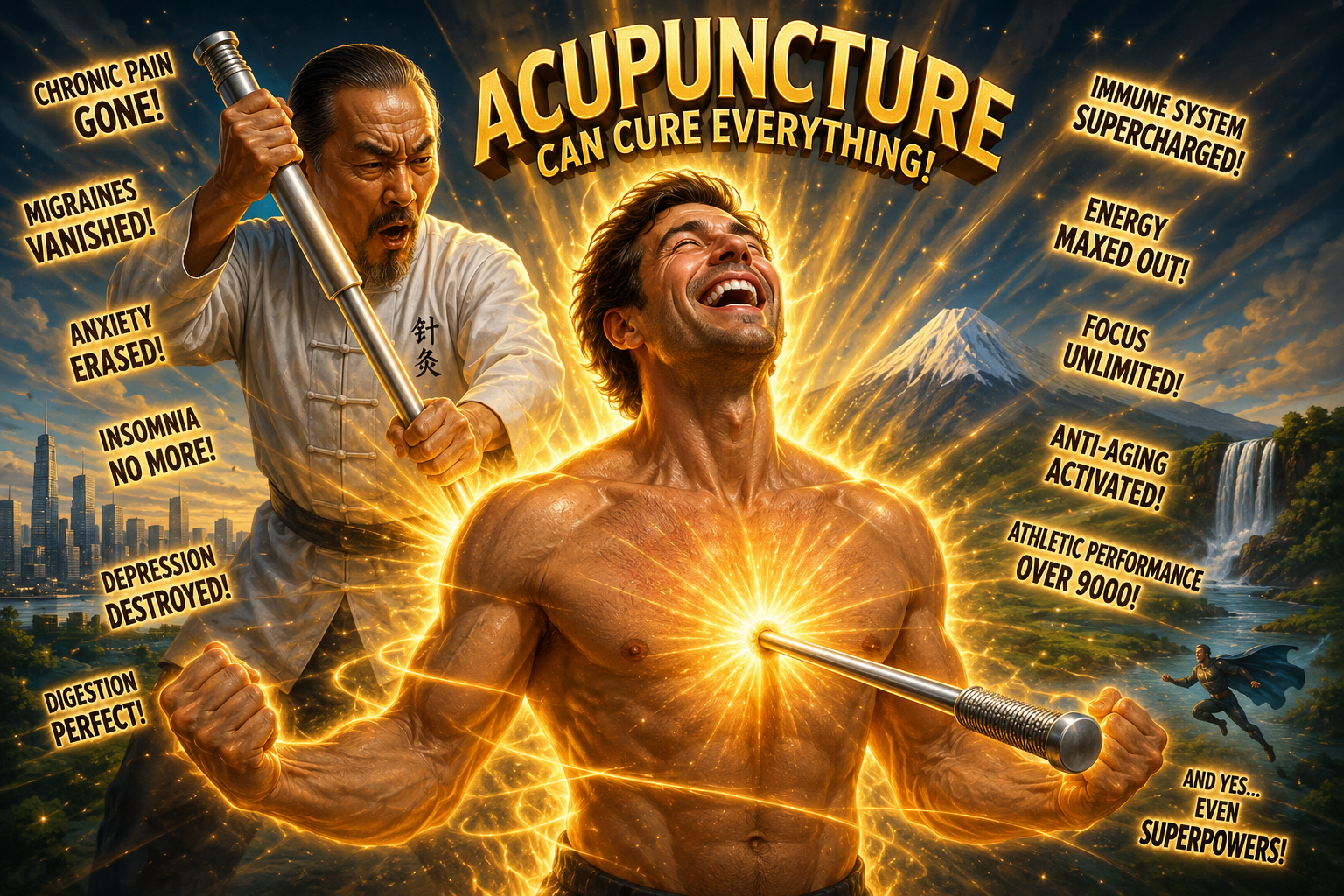
The New York Times included this line in its morning newsletter yesterday (5/11/2026):
“Acupuncture works, of course. The studies are clear. People seek it out for treatment of all sorts of ills, from chronic pain and migraines to anxiety and insomnia. The discovery of the interstitium, Cooper writes, may help us better understand how it works.”
I had to read it twice.
Not because the Times discussed acupuncture. That’s unsurprising. But because it presented the effectiveness of acupuncture as an unquestioned scientific fact. Not “some evidence suggests.” Not “patients often report benefits.” No. “Acupuncture works, of course.”
That is a much stronger claim than the evidence actually supports.
The central problem is something called sham acupuncture. Researchers long ago realized that if acupuncture truly works because specific needles are inserted into specific points along invisible energy meridians, then “real” acupuncture should substantially outperform fake acupuncture. So researchers created placebo versions of acupuncture using retractable needles, shallow needling, incorrect acupuncture points, or random needle placement.
And here’s the problem: fake acupuncture basically performs as well as the “real” thing.
This is not some fringe criticism. Even meta-analyses generally favorable toward acupuncture acknowledge that the differences between real and sham acupuncture are often “relatively modest” or non-existent. One review summarized the issue bluntly: “the differences between the results obtained with real and sham acupuncture are small and not clinically relevant.”
That is devastating for the stronger claims made about acupuncture.
If the needles, locations, and meridians are truly the mechanism, then doing it incorrectly should not work nearly as well. Yet sham acupuncture frequently produces meaningful improvements in pain and symptoms. Researchers have repeatedly noted that the ritual itself — the attention from a practitioner, expectation of relief, touch, bodily sensation, and placebo effects — appears to account for a substantial portion of the reported benefits.
To be clear, this does not mean patients are lying or imagining things. Placebo effects are real. Ritualized care can absolutely affect subjective experiences like pain, anxiety, stress, and insomnia. Symptoms also naturally fluctuate over time, and many people seek treatment when symptoms are already at their worst, meaning some improvement is statistically likely regardless of intervention.
But that is very different from saying that ancient Chinese theories about qi and meridians have been scientifically validated.
The Times article then makes another common move: mechanism inflation.
It suggests that the “discovery of the interstitium” — connective tissue spaces in the body — may help explain how acupuncture works. But proposing a mechanism is not evidence that a treatment actually works in the specific way claimed.
Medicine is full of treatments with plausible mechanisms that ultimately fail in rigorous trials. A mechanism cannot rescue weak efficacy evidence. Discovering connective tissue does not somehow validate the existence of invisible energy channels any more than discovering gravity validates astrology.
In fact, the mechanism discussion is especially strange precisely because the sham acupuncture studies already undermine the claim that specific acupuncture points are uniquely important. If fake acupuncture often works similarly to “real” acupuncture, then attaching acupuncture to newly discussed anatomical structures does not solve the core evidentiary problem.
And this is where the cultural double standard becomes interesting. Imagine the New York Times casually writing:
“Prayer works, of course. The studies are clear.”
Readers would immediately demand randomized controlled trials, proper controls, placebo comparisons, publication bias analysis, and mechanistic explanations. Skepticism would appear instantly.
But acupuncture often receives a very different treatment, especially among educated secular audiences. Once a healing ritual is framed as ancient, Eastern, holistic, and wellness-oriented, skepticism frequently softens. Journalists who would aggressively interrogate Christian faith healing suddenly become remarkably deferential.
That does not mean acupuncture has no effects whatsoever. The evidence suggests that people often do report feeling better after acupuncture sessions, whether it is sham or real. But the strongest evidence points toward contextual and placebo-related effects rather than the dramatic claims often implied in popular coverage.
And that distinction matters.
“People sometimes feel better after an elaborate healing ritual” is a reasonable statement.
“Acupuncture works, of course,” is journalistic malpractice.