

Recently, the Florida Commissioner of Education sent a letter to a sociology professor at Florida SouthWestern State College accusing him of violating state law by teaching “gender ideology” in an Introduction to Sociology course. Since I haven’t seen the letter online elsewhere, I’m going to post an image of the letter along with the content here so everyone can see it:
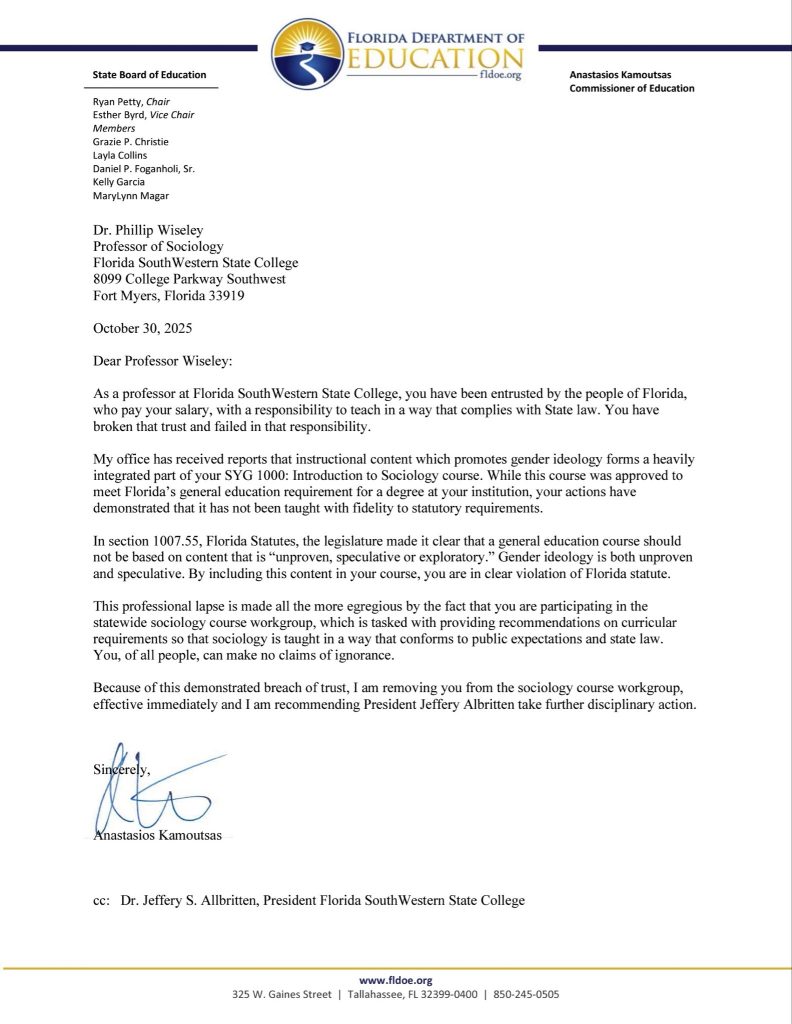
Here’s the full text of the letter typed out:
Dr. Phillip Wiseley
Professor of Sociology
Florida SouthWestern State College
8099 College Parkway Southwest
Fort Myers, Florida 33919
October 30, 2025
Dear Professor Wiseley:
As a professor at Florida SouthWestern State College, you have been entrusted by the people of Florida, who pay your salary, with a responsibility to teach in a way that complies with State law. You have broken that trust and failed in that responsibility.
My office has received reports that instructional content which promotes gender ideology forms a heavily integrated part of your SYG 1000: Introduction to Sociology course. While this course was approved to meet Florida’s general education requirement for a degree at your institution, your actions have demonstrated that it has not been taught with fidelity to statutory requirements.
In section 1007.55, Florida Statutes, the legislature made it clear that a general education course should not be based on content that is “unproven, speculative or exploratory.” Gender ideology is both unproven and speculative. By including this content in your course, youa re in clear violation of Florida statute.
This professional lapse is made all the more egregious by the fact that you are participating in the statewide sociology course workgroup, which is tasked with providing recommendations on curricular requirements so that sociology is taught in a way that conforms to public expectations and state law. You, of all people, can make no claims of ignorance.
Because of this demonstrated breach of trust, I am removing you from the sociology course workgroup effective immediately and I am recommending President Jeffery Albritten take further disciplinary action.
Sincerely,
Anastasios Kamoutsas
cc: Dr. Jeffery S. Allbritten, President Florida SouthWestern State College
There is a key phrase in the letter that struck me as a sociologist: gender ideology. That phrase is doing a lot of work in the letter. According to the Commissioner, it is “unproven” and “speculative,” and therefore cannot be included in a general education course under Florida statute.
There is just one small problem.
“Gender ideology” is not a concept that exists in sociology.
I have been studying and teaching for more than twenty years. I have taught Introduction to Sociology countless times. I have read thousands of sociological articles, hundreds of books, and dozens of textbooks. I have never once encountered a peer-reviewed sociological article that treats “gender ideology” as a defined scientific concept.
That’s because it isn’t one.
What sociologists actually study are things like:
- Gender roles — the expectations societies place on men and women
- Gender norms — socially accepted patterns of behavior
- Gender socialization — how individuals learn gender expectations
- Gender inequality — differences in outcomes between men and women
- Gender identity — how individuals understand and experience gender
These are longstanding, well-defined areas of research within sociology and related disciplines. They appear in introductory textbooks, peer-reviewed journals, and major research programs across the social sciences.
“Gender ideology,” by contrast, is a political phrase, not a scientific one. It’s used primarily to argue that gender is not a social construct (which would make gender the same thing as biological sex).
Which raises a fairly obvious question: How exactly are professors supposed to avoid teaching something that has no clear definition?
The problem becomes even stranger when you look at the official course framework for Introduction to Sociology created by the State University System of Florida itself.
That framework explicitly discusses gender as a legitimate area of sociological inquiry. For example, it explains that while biological sex is determined by chromosomes and reproductive anatomy, the ways that men and women behave are also shaped by social processes and expectations. The framework even notes that studies examining how men and women navigate their social worlds are known as gender analyses.
In other words, the state’s own sociology curriculum recognizes gender as a valid subject of sociological research.
Yet a professor is now being reprimanded for allegedly teaching something called “gender ideology,” a phrase that does not appear in the disciplinary literature and is not defined in the statute cited in the letter.
This creates an obvious dilemma.
If the state wants to prohibit a specific type of content, it needs to define what that content actually is. Otherwise, enforcement becomes arbitrary. An official’s understanding of “gender ideology” could be, well, anything, but most likely it will be whatever they don’t agree with for religious or political or personal reasons. If a professor is covering gender norms, gender roles, or gender inequality — all standard topics in introductory sociology courses — they could be deemed to violate the law by any of the many morons that Republicans have put into office who don’t have a clue what they are talking about. Those morons managed to get a bully stick and now get to hit anyone with a modicum of education over the head until those people fall into line and teach whatever these morons think should be true. Not what is true, but what these people want to believe is true.
Laws that regulate education should be clear enough that instructors can reasonably understand what is permitted and what is prohibited.
But when the key term in an accusation has no scholarly definition, no statutory definition, and no place in the discipline being regulated, it becomes impossible to know where the boundary lies. My guess is: that’s the point. If the law isn’t clear, enforcing the law is entirely subject to the whims of those in power.
That is not a healthy place for a university system — or for science more broadly.
2 thoughts on “What Is “Gender Ideology”?”
Comments are closed.