

If you’re lucky, you never read Putnam and Campbell’s book, American Grace. If you’re unlucky, you made your way through their ponderous tome and were exposed to some really remarkable claims like the following:
p. 444 “In this chapter we discover, first, that religious Americans are, in fact, more generous neighbors and more conscientious citizens than their secular counterparts. On the other hand, they are also less tolerant of dissent than secular Americans, an important civic deficiency. Nevertheless, for the most part, the evidence we review suggests that religiously observant Americans are more civic and in some respects simply “nicer.”
p. 450 “In short, virtually every part of the American philanthropic spectrum benefits disproportionately from giving by religiously observant men and women, but this is especially true for organizations serving the needy.”
Here’s the deal… Religious Americans are more generous than secular Americans when it comes to giving to religions. And that is to be expected. Why would secular Americans pay “dues” to clubs to which they don’t belong? Not surprisingly, they don’t. At least, they don’t give very much to religions (they do give some).
But where Putnam and Campbell went too far is in claiming that religious Americans are more generous when it comes to secular charities. You know why they went too far there?
Because that was never actually true according to their own data!
I just had a paper come out in Secularism & Nonreligion that shows secular Americans (category 1: atheists and agnostics; category 2: religious nones) give less than religious people to religions, but they give just as much to secular charities (and, in some cases, more). But, importantly, religious affiliation explains basically none of the variation in giving to charities. Far more important is how much money someone makes and their affinity toward the aims of the charity.
But here’s the kicker. While Putnam and Campbell claimed that religious Americans were more generous than secular Americans, including across the “philanthrophic spectrum,” their data never actually showed that. For those who aren’t aware of what they did, they combined all of the Americans without a religious affiliation with all of the Americans who had a religious affiliation but rarely to never attended religious services, and made those people into “secular” Americans. Then they compared those people to religiously affiliated people who regularly attend religious services. Effectively, they “cooked the books” to make sure religious Americans came out looking great.
But, if you know how to analyze data, which I do, you can quickly see that Putnam and Campbell were being deceptive at best here (and outright lying at worst).
I uploaded my code to OSF so anyone can check my analyses, and you can get the Faith Matters 2006 dataset from The Arda (hat tip to the folks at The Arda, who I really like).
It took me about 30 minutes to find all the relevant variables I needed and to clean them up, then I did a couple of very simple analyses to show that Putnam and Campbell misled their readers, and not just a little bit.
Let’s start with the most basic question: who gives more to secular/nonreligious charities, religious people or nonreligious people? If you actually divide up the Faith Matters sample by religious affiliation, creating a dummy code for those who have a (1) religious affiliation and (0) those who don’t, and do a very simple regression analysis, it turns out nonreligious Americans, statistically, give more than religious Americans, to secular charities: b = -.238, p = .0024.
For those who don’t do statistics, let me interpret this for you. The “b” is a slope coefficient. It basically tells us how much change we get when we move from no religion (at zero) to religious affiliation (at one). We get a .238 unit decline on the donations to secular charities scale. And what is the donation to secular charities scale?
- None
- Less than $100
- $100 to less than $500
- $500 to less than $1,000
- $1,000 to less than $5,000
- $5,000 or more
With an intercept of 3.153 in that model, what this tells us is that the average nonreligious person falls around 3.391 on this 6-point scale. The average religious person falls around 3.15333. So, lower. And, the p-value tells us that the difference is statistically significant, which means we can rule out chance here.
But, I would be remiss (and a hypocrite) if I didn’t include the R2 or coefficient of determination, which tells us how much of the variation in donations to secular charities is explained by religious affiliation.
Are you ready for it?
Wait for it!
A whopping: .003522 (adjusted). Again, what does that mean in lay terms? 0.35% of the variation in giving to charities is explained by religious affiliation (that is out of 100%; so, nothing, really). In other words, religious affiliation is completely meaningless when it comes to understanding giving to secular charities.
I’m sure that was in American Grace somewhere, right? I mean, they are rigorous, honest scholars who would never misrepresent their findings, right? Right?
Okay. As if that isn’t bad enough, let’s look at another variable. Included in the survey is a question about surety of belief in a god. Here is the question:
We’re going to ask you about various things that some people believe in and others don’t. Are you absolutely sure, somewhat sure, not quite sure, not at all sure, or are you sure you do not believe in God?”
Here are the response options:
- Don’t believe (0)
- Not at all sure (1)
- Not quite sure (2)
- Somewhat sure (3)
- Absolutely sure (4)
With another simplified regression model, I regressed amount donated to secular charities on surety of belief in a god, keeping surety of belief in a god as a continuous or numeric variable (even though it is probably better understood as a categorical variable, but, in this instance, they made it an interval-like ordinal variable).
And the results?
In the 2006 Faith Matters survey, surety of belief in a god matters for giving: b = -0.25314, p < .001. Again, let me translate this for those who don’t do statistics. We’re using the same dependent variable as above that ranges from 1 to 6. The negative slope means that, as we increase from (0) “don’t believe” up to (4) “absolutely sure,” the amount donated goes down. For every unit change we go up in belief surety, there is a drop of .25314 points on the donation to secular charities scale. Which means, an atheist falls around 3.867 on the scale, while someone who said they are absolutely sure they believe in a god would fall around 2.8544. Atheists give more to secular charities than do theists.
That is in Putnam and Campbell’s original dataset.
It was always there.
They hid it with some careful data manipulation and sold their readers the opposite conclusion. And, for my stickler stats geeks out there, I have to report the variation explained: R2 = .03319. Someone’s surety that there is or is not a god explains 3.3% of the variation in giving to secular charities. It’s not a big deal, but above the cutoff for negligible; it’s a small effect.
I seem to recall there being some religious prohibition against doing this. Something like:
Thou shall not bear false witness against thy neighbor.
Well, if Putnam and Campbell have atheist neighbors, I think they violated that commandment.
Just to be extra cautious, I went ahead and put together a slighly more robust model that included several control variables – income, age, educational attainment, and gender – along with religious affiliation (as a dummy code) and surety of one’s god belief. Religious affiliation isn’t even statistically significant in that model (b = -0.0224, p = .778). Gender also isn’t significant. The other variables are. The variation explained is much higher: R2 = .2731. With all of those variables controlled, does surety of belief in a god still matter? Here’s an average marginal effects plot with the answer:
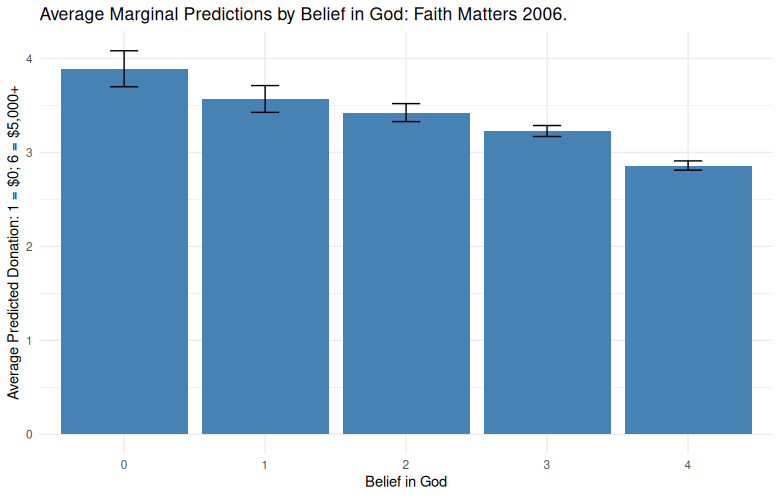
On the bottom or x-axis is surety of belief in a god; 0 = atheist; 4 = theist. On the left side or y-axis is amount donated. The brackets at the top of each column give error margins. Net of income, age, gender, educational attainment, and religious affiliation, atheists gave more to secular charities in 2006 than did theists. That is exactly the opposite of what Putnam and Campbell claimed in their book.
Hmmm….
If I’m going to be as fair as possible to Putnam and Campbell, they didn’t actually test what I did and instead put all of their eggs in the religious attendance basket, probably hoping no one would ask to inspect their egg basket and see what was at the bottom. When you lift up the attendance eggs, it turns out they are hiding a very different picture.
The 2006 Faith Matters survey that Putnam and Campbell used for their book tells a very different story when you analyze it fairly: secular Americans are at least as generous as religious Americans when it comes to secular charities, if not more so.
I’d sure love to know how they justified selling the complete misrepresentation of their data to the American public.